




HOPEGOLD (SHENZHEN) BUSINESS MANAGEMENT CONSULTING CO.,LTD
Global professional notarization and certification service agency
Contact Us
Hotline: +86-755-28261216
Email: Bruce@hopegold.cn

Georgia Apostille Guide: GSCCCA Requirements, $3 Fee and 1–2 Day Processing
Georgia Apostille Guide: GSCCCA Requirements, $3 Fee and 1–2 Day Processing
Georgia apostilles are issued by the Georgia Superior Court Clerks' Cooperative Authority (GSCCCA), not the Secretary of State. The official fee is $3 per document, mail-in service normally takes one to two business days, and walk-in service at the Atlanta office is same day.
- You hold a Georgia-issued document — a birth, death or marriage certificate, a divorce decree, a court document or a corporate filing — and you need it recognised in a country that is party to the Apostille Convention.
- You have a document that a Georgia notary public notarized — a power of attorney, an affidavit, a translation, a diploma or a school transcript — and it has to be authenticated for use abroad.
- You tried the Secretary of State's office first and were told to go somewhere else.
- You are outside the United States with a Georgia document in hand, and what you really need to know is how payment and return shipping actually work.
Tell us the document type and the destination country and we will come back with the exact steps, the service fee and the timeline — free consultation, no charge and no follow-up pressure. Talk to us directly.
What a Georgia apostille is, and when you need one
An apostille is the certificate issued under the Convention of 5 October 1961 Abolishing the Requirement of Legalisation for Foreign Public Documents. The Convention was signed on 5 October 1961, entered into force on 24 January 1965, and has 130 Contracting Parties as of the HCCH status table updated 30 June 2026. Mainland China has applied it since 7 November 2023.
One apostille on a Georgia public document makes it acceptable in every Contracting Party, and no consular legalisation is needed on top. What the apostille certifies is narrow: the signature, the capacity of the signatory and the seal or stamp on the document. It does not certify the content of the document, and the receiving authority keeps the right to accept or refuse the document on its own terms.
There are three cases where you do not need an apostille. A document that will only be used inside the United States, its territories or possessions does not need one. A document going to a country that is not party to the Convention does not get one — that route runs through a Great Seal Certification and then consular legalisation. And documents moving between mainland China and Hong Kong or Macao do not use the Convention at all, because those territories are not separate Contracting Parties; that route is notarisation by a China-appointed attesting officer plus transmission through China Legal Service (H.K.) Limited.
One boundary worth remembering: a document going to a foreign embassy or consulate located inside the United States counts as an international document going to that foreign country, so it still takes an apostille.
Which authority handles it: the GSCCCA, not the Secretary of State
In most US states the apostille comes from the Secretary of State. Georgia is one of the exceptions. GSCCCA states it plainly: “The GSCCCA is the only state agency authorized to issue apostilles for documents originating in the State of Georgia.” Send a Georgia birth certificate to the Secretary of State's office and it comes back to you unprocessed.
Georgia has two state agencies authorised to authenticate documents, plus a county office, and the right one depends on where the document is going.
| Agency | What it issues | Contact |
|---|---|---|
| Georgia Superior Court Clerks' Cooperative Authority (GSCCCA) | Apostilles for documents originating in Georgia (destination: a Contracting Party country). Also issues Certifications of Notary Public, for documents used within the US, a US territory or a US embassy — typically visa requests. | 1875 Century Blvd., Ste. 100, Atlanta, GA 30345 404-327-6023 |
| Georgia Secretary of State | Great Seal Certification, for documents going to countries that are not party to the Convention. Accepts notary certifications only from the notary's commissioning county. | 404-656-2871 |
| Clerk of Superior Court in the notary's commissioning county | Certification of Notary Public — proof that a notary held a commission during a particular term of office. Not used together with an apostille. | Per county |
The GSCCCA office, hours and contact details
- Address: 1875 Century Blvd., Ste. 100, Atlanta, GA 30345
- Walk-in hours: 9:00 a.m. to 4:00 p.m., Monday to Friday. No appointment is necessary.
- Mail: same address, with the recipient line Attn: Notary Division
- Phone: 404-327-6023 or 800-304-5175 | Email: notary@gsccca.org
GSCCCA also states, in capitals on its own page: “Our office does NOT offer notary services.” Whatever has to be notarized has to be notarized somewhere else, before it reaches Atlanta.
Documents required: what GSCCCA accepts, and what it refuses
GSCCCA takes two classes of document, and telling them apart is the first fork in the road.
Class 1 — Georgia-issued publicly recorded documents
These must be official certified copies carrying the signature and seal of the issuing Georgia state or county official. GSCCCA's own wording: “These documents are never notarized.” The class covers birth certificates, death certificates, marriage certificates, divorce decrees, court documents, documents filed with a Georgia County Clerk of Superior Court, and corporate documents on file with the Georgia Secretary of State Corporations Division.
Two details in that list trip people up. Corporate documents must be certified copies issued by the current Secretary of State — either issued directly from that office or downloaded from its website. And divorce decrees have a shortcut: some counties participate in the eCertification programme, and an apostille can be issued on the printed digital version of a certified copy.
Class 2 — Georgia-notarized documents
The examples GSCCCA gives are powers of attorney, affidavits, corporate documents, translations, and diplomas or school transcripts. These must be properly notarized under Georgia law before the office can authenticate them. GSCCCA's instruction is unambiguous: “Any document requiring notarization must be notarized prior to submission to the GSCCCA.”
The notarial certificate itself has six requirements, all of them from GSCCCA's page:
- A completed notarial certificate identifying the type of notarial act performed.
- The notary signs by hand in ink, using exactly the name shown on the notary's commission.
- The exact date of notarization appears on the certificate.
- The signature matches both the name and the signature on the commission.
- The seal or stamp matches the name on the commission and contains the notary's name, the county of commission, the words “Notary Public” and the name of the state.
- The document carries a clear impression of the seal or stamp.
| GSCCCA can apostille | GSCCCA cannot apostille |
|---|---|
| Georgia-issued vital records — birth, death and marriage certificates — as official certified copies | Out-of-state documents — contact the state that issued them |
| Divorce decrees, including printed digital copies from the eCertification programme | Federal documents signed and sealed by a federal agency or federal court, including a Consular Report of Birth Abroad — those go to the US Department of State's Office of Authentications |
| Court documents, and documents filed with a Georgia County Clerk of Superior Court | Photocopies — unless a Georgia notary has properly certified the copy |
| Corporate documents on file with the Georgia Secretary of State Corporations Division, certified by the current Secretary of State | Documents issued by a foreign country |
| Georgia-notarized documents — powers of attorney, affidavits, translations, diplomas and school transcripts | Documents going to countries that are not party to the Convention |
| — | Documents that will be used inside the United States, its territories or possessions |
Fees and processing time
The official apostille fee in Georgia is $3.00 per document. It is charged per document, not per page, and it is the lowest tier in the country. For scale: Massachusetts charges $6, New York and Florida $10, Texas $15, and California $20 — plus $6 per additional distinct public official's signature at a counter.
| Item | Official amount | Payable to |
|---|---|---|
| Apostille | $3.00 per document | GSCCCA |
| Certification of Notary Public | $2.00 per document (not used with an apostille) | GSCCCA — for use within the US, a US territory or a US embassy, typically visa requests |
| Birth certificate, certified copy | $25.00, plus $5.00 for each additional copy | Georgia Department of Public Health, State Office of Vital Records |
| Death certificate, certified copy | $25.00, plus $5.00 for each additional copy | Georgia Department of Public Health, State Office of Vital Records |
| Marriage certificate, certified copy | $10.00, plus $5.00 for each additional copy | State Office of Vital Records, or the county issuing authority holding the record |
| Notarization, where the document requires it | Set by the notary | The Georgia notary public |
Processing time. Mail-in service is, in GSCCCA's words, “normally one to two business days.” Walk-in service is while you wait — with the caveat that GSCCCA “reserves the right to limit the number of documents presented to our office on a while-you-wait service.”
The part that actually costs you weeks is the document underneath the apostille. Georgia's State Office of Vital Records processes and ships mail orders within 10 weeks — its own wording is “Processed and shipped within 10 weeks.” Applicants often assume the apostille is what takes a month. What takes a month is getting the certified copy that the apostille has to sit on.
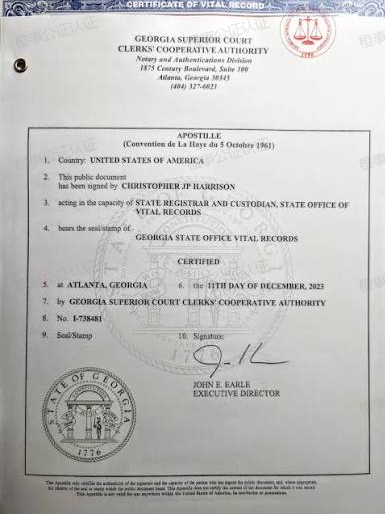
The sample above is what a Georgia apostille looks like. The issuing authority on the face of the certificate is the GSCCCA, the place of issue is Atlanta, and there is no mention of the Secretary of State — which is exactly how you can tell a Georgia apostille apart from one issued in almost any other state.
Step-by-step process
Five steps. The first one is the one most people skip, and it decides everything that follows.
- Confirm the requirement with the receiving party. Which country, whether a translation is wanted, whether they need a certified copy of the apostilled document, and whether there is a validity window on the certificate.
- Obtain the right version of the document. Publicly recorded documents need an official certified copy with the issuing official's signature and seal. Documents that require notarization have to be notarized first.
- Decide which route applies. Publicly recorded documents go straight to GSCCCA. Notarized documents must be notarized before submission — there is no way to fix that at the counter.
- Submit to GSCCCA and collect the apostille. Walk-in is while you wait; mail-in is normally one to two business days.
- Deal with translation if the destination requires it. A translation must itself be notarized and apostilled separately. Do not slip a self-translated page into an already-authenticated document.
The rules most people miss
Good news first: Georgia does not require county certification before the apostille. GSCCCA's page says it outright — “Notarized documents do not require additional county certification prior to obtaining the apostille.” New York is the opposite: a birth, death or marriage certificate issued by a county or local registrar there must be certified by the issuing county clerk before the state will touch it. Applicants who have done a New York or California document often assume Georgia works the same way and add a step that does not exist.
The trap is the mirror image of that. Notarization is not optional, and it cannot be done at the GSCCCA counter. Two sentences from GSCCCA's own page settle it: “Any document requiring notarization must be notarized prior to submission to the GSCCCA,” and “Our office does NOT offer notary services.” A power of attorney signed abroad and mailed to Atlanta without a notarial certificate on it will be returned. The notarial certificate has to be on the document before it arrives.
There is one more distinction worth holding on to. Whether a document is “publicly recorded” or “notarized” is what decides the route, and it is decided by the document's own nature, not by preference. GSCCCA's guidance for publicly recorded documents is that they are never notarized — what gets authenticated is the certified copy bearing the issuing official's signature and seal.
Mail or walk-in
Documents must be originals either way, and both routes use the same address. What differs is payment, paperwork and speed.
| Walk-in | Mail-in | |
|---|---|---|
| Address | 1875 Century Blvd., Ste. 100, Atlanta, GA 30345 | Same address, addressed to Attn: Notary Division |
| Hours / order of work | 9:00 a.m. to 4:00 p.m., Monday to Friday, no appointment | Processed in the order received |
| Payment | Cash, personal or company cheque, money order, credit card — or a credit-card Pre-Payment Voucher for third-party hand delivery | Cheque, money order or credit-card Pre-Payment Voucher. Cash is not accepted by mail. |
| Processing time | While you wait; GSCCCA may limit the number of documents it handles that way | Normally one to two business days |
| Must be enclosed | Originals and payment | A cover or request letter naming the destination country and giving contact details, plus a pre-paid, self-addressed envelope or airbill for return |
| Return label | — | FedEx or UPS return airbills must be computer generated; handwritten airbills are not accepted |
One payment detail that catches people out: cheques “must have a pre-printed name and address on check.” A handwritten cheque is not accepted, whether you walk in or mail in.
Where overseas applicants get stuck
If you are outside the United States with a Georgia document, four things stand between you and a finished apostille.
1. Payment. By mail, cash is out, and a cheque has to carry a pre-printed name and address. If you cannot produce a US-dollar cheque to those specifications, the practical alternative is GSCCCA's credit-card Pre-Payment Voucher system — which requires a card that can be charged in US dollars.
2. Return shipping. You must send a pre-paid, self-addressed envelope or airbill along with the documents. For an international return, that airbill has to be bought before you ship, and if you use FedEx or UPS it has to be computer generated. Improvising after the fact does not work, because the office will not accept a handwritten label.
3. Notarization. If your document needs a notarial certificate, the notary has to be a Georgia notary public. Signing the document abroad and mailing it in leaves that requirement unmet — and the office does not notarize, so there is nothing to fix on arrival.
4. The certified copy underneath. If you do not yet hold the official certified copy, you are queuing at the vital records office, which ships mail orders within 10 weeks. That queue, not the apostille, is where the calendar goes.
Cost breakdown
A Georgia apostille is not a single price. The total is made of several charges paid to different parties, and no one party can collect the others on your behalf.
| Cost item | Typical level | Paid to |
|---|---|---|
| Official apostille fee | $3.00 per document | GSCCCA |
| Official vital records certified copy | Birth and death $25.00; marriage $10.00 — plus $5.00 per additional copy | State Office of Vital Records, or the county issuing authority |
| Notarization, if the document needs it | Set by the notary | The Georgia notary public |
| International courier and return shipping | Quoted by the carrier, charged in both directions | The courier |
| Translation, if the destination requires it | Priced by language pair and page count | The translation provider |
| Service fee | Quoted per document type, number of copies and destination | 橙事公证认证 — Get a quote → |
When to use a service
The official fee is $3 and the process is not complicated, so plenty of people should simply do it themselves: you are in Georgia, your document is already an official certified copy, and you can walk into the Atlanta office. The situations below are the ones where using a service usually costs less than the delay.
- The document has to be notarized and you are not in Georgia.
- You cannot produce a US-dollar cheque with a pre-printed name and address, and the Pre-Payment Voucher route is not workable for you.
- You still need a certified copy and you are not sure whether to approach the State Office of Vital Records or a county office.
- The document is going to mainland China and a translation is required — and the translation must itself be notarized and apostilled.
- You want to reduce the risk of a rejection, because a returned submission means re-assembling the file and queuing again.
- You have several documents or several copies to do at once, and the special requirements are easy to miss one by one.
Common rejection reasons
- Sent to the Secretary of State. Apostilles come only from GSCCCA; a wrong-agency submission costs a full round trip.
- The document was not issued in Georgia. Out-of-state documents go back to the issuing state; federal documents go to the US Department of State's Office of Authentications.
- A photocopy or ordinary printout was submitted. Publicly recorded documents must be official certified copies bearing the issuing official's signature and seal.
- Notarization was missing or defective — no notarial certificate, a signature that does not match the commission, no notarization date, or an incomplete or unclear seal.
- The destination country is not party to the Convention. That is not an apostille case at all; it runs through a Great Seal Certification and then consular legalisation.
- Mail-in paperwork was incomplete — no cover letter naming the destination country, no pre-paid return envelope, or a handwritten return airbill.
Tell us the document type and the destination country and we will work out which route applies and what has to be fixed first, then give you the steps, the service fee and the timeline — free consultation, no charge and no follow-up pressure. Contact us →
How to verify authenticity
When the document comes back, check six things: the issuing country, the signatory's name and capacity, the name on the seal, the place of issue, the certificate number, and the issuing authority and date.
Georgia has no public online lookup for apostille numbers. In practice you verify by comparing the issuing authority's name and address, the number format and the signatory against a known-good Georgia apostille, or by calling GSCCCA on 404-327-6023. And keep the scope in mind: the apostille certifies only the signature, the capacity of the signatory and the seal or stamp. It says nothing about whether the content of the document is accurate, and the receiving authority can still apply its own standards.
FAQ
1. Can a Georgia apostille be used in mainland China?
Yes. The Convention has applied to mainland China since 7 November 2023, so a single apostille on a Georgia public document is enough. Note that documents moving between mainland China and Hong Kong or Macao do not use the Convention.
2. Do I still need the Chinese embassy or consulate to legalise it?
No. The apostille replaces consular legalisation. Consular legalisation only comes back into play when the destination country is not party to the Convention — and that route starts with a Great Seal Certification from the Georgia Secretary of State.
3. Can GSCCCA apostille a document from another state?
No. Out-of-state documents are refused and have to go to the state that issued them. Federal documents, including a Consular Report of Birth Abroad, go to the US Department of State's Office of Authentications, where the fee is $20 per document.
4. Do birth, marriage and death certificates need to be notarized first?
No. GSCCCA states that publicly recorded documents “are never notarized.” What they need is an official certified copy with the issuing official's signature and seal. The documents that do need notarization are powers of attorney, affidavits, translations, and diplomas or transcripts.
5. The official fee is only $3 — why does a service charge more?
The $3 is GSCCCA's authentication fee and nothing else. It does not cover obtaining the certified copy, notarization, translation or international shipping, and it does not cover the time spent working out which route applies and assembling the paperwork. A service fee pays for that coordination and for the error-checking that goes with it.
6. Can I do this myself from outside the United States?
If the document is already an official certified copy and needs no notarization, mailing it in yourself is possible in theory — provided you can arrange payment and a pre-paid return airbill. If the document needs notarization, or you still have to obtain the certified copy, it is usually not something you can complete on your own from abroad.
Tell us the document type and the destination country and we will come back with the steps, the service fee and the timeline — free consultation, no charge and no follow-up pressure. Ask us a question →
Sources / last verified
- Georgia Superior Court Clerks' Cooperative Authority, “Apostilles – General Information”: document authentication routes, accepted and refused documents, notarization requirements, official fees, office hours, mailing instructions and payment methods — checked 14 October 2026.
- Georgia Department of Public Health, Vital Records: “Fees and Acceptable Forms of Payment” (birth $25.00, death $25.00, marriage $10.00, plus $5.00 per additional copy; page updated 11 March 2026) and “How Do I Order Georgia Birth and Death Records by Mail” (State Office of Vital Records, 1680 Phoenix Boulevard, Suite 100, Atlanta, GA 30349; processed and shipped within 10 weeks).
- US Department of State, Office of Authentications: scope of federal documents and the $20 per document fee — checked 12 October 2026.
- HCCH, Apostille Convention status table: signed 5 October 1961, in force 24 January 1965, 130 Contracting Parties as of 30 June 2026.
Fees and timelines above are those published on the dates checked. Official charges change, so confirm against the authority's current page before quoting a figure to a client.

