




HOPEGOLD (SHENZHEN) BUSINESS MANAGEMENT CONSULTING CO.,LTD
Global professional notarization and certification service agency
Contact Us
Hotline: +86-755-28261216
Email: Bruce@hopegold.cn

Delaware Apostille Guide: Division of Corporations, $30 Per Batch and Same-Day Processing
Delaware Apostille Guide: Division of Corporations, $30 Per Batch and Same-Day Processing
Delaware apostilles are issued by the Secretary of State's Division of Corporations — the same office that handles corporate filings, not a separate authentication desk. For personal use the official fee is $30 for any documents submitted at the same time, mailed requests are normally processed the same business day, and hand-delivered requests are completed within two hours.
- You hold a Delaware document — a birth, death or marriage certificate, a divorce decree, a court document or a corporate filing — and it has to be recognised in a country that is party to the Apostille Convention.
- You have a document that a Delaware notary public notarized — a power of attorney, an affidavit, a translation, a diploma or a school transcript — and it needs an apostille for use abroad.
- You were told to send it to "the Secretary of State" and you cannot work out which division actually issues the certificate, or what has to be attached to it.
- You are outside the United States with a Delaware document in hand, and what you really need to know is how payment, notarization and return shipping work in practice.
Tell us the document type and the destination country and we will come back with the exact steps, the service fee and the timeline — free consultation, no charge and no follow-up pressure. Talk to us directly.
What a Delaware apostille is, and when you need one
An apostille is the certificate issued under the Convention of 5 October 1961 Abolishing the Requirement of Legalisation for Foreign Public Documents. The Convention was signed on 5 October 1961, entered into force on 24 January 1965, and has 130 Contracting Parties as of the HCCH status table updated 30 June 2026. Mainland China has applied it since 7 November 2023.
Delaware's own wording for the two certificates is the cleanest way to tell them apart. The Division of Corporations writes that "An Apostille is an international certification of documents that are destined for countries that are members of The Hague Convention" and that "An Authentication is a certification of documents that are destined for countries that are not members of The Hague Convention." Same office, same counter, different certificate — and the destination country decides which one you get.
What an apostille actually certifies is the signature, the capacity of the person who signed and, where relevant, the identity of the seal on the document. It does not certify that the contents of the document are true. A birth certificate with an apostille is not a statement by the State of Delaware that the birth details are correct — it is a statement that the signature and seal on the certified copy are genuine.
Two boundary cases are worth knowing before you start. First, a single apostille covers the whole document it is attached to; you do not need one per page. Second, the Convention does not apply to documents moving between mainland China and Hong Kong or Macao — those follow a separate arrangement, so a Delaware apostille is the wrong instrument for that route.
Which authority handles it: the Division of Corporations, not a certification desk
This is the first thing that trips people up. In most states the apostille comes from a dedicated authentication unit inside the Secretary of State's office. In Delaware it comes from the Division of Corporations — a division whose name mentions only companies, yet which also issues apostilles, authentications and Notary Good Standing certificates. The State of Delaware's own certificates guide states plainly that "The Apostille is prepared by the Delaware Secretary of State, Division of Corporations."
The scope is set out the same way: "The Division of Corporations can authenticate or Apostille documents signed by a Delaware notary or Delaware Public Official." That single sentence contains the whole test. If the signature on your document is not a Delaware notary's and not a Delaware public official's, this office is not the right place for it — more on that below.
The Dover office, hours and contact details
| Item | Detail |
|---|---|
| Issuing authority | Delaware Secretary of State, Division of Corporations |
| Regular mail (PO Box) | Division of Corporations, PO Box 898, Dover, DE 19903 |
| Express mail and in-person | John G. Townsend Building, 401 Federal Street, Suite 4, Dover, DE 19901 |
| Appointments (in-person apostille) | (302) 739-3077 |
| General enquiries | (302) 739-3073 — operators 8:00am to 4:30pm, Monday to Friday, excluding state holidays |
| In-person service | By appointment only — do not turn up without one |
| Return of documents | Routine first-class mail unless a prepaid Priority USPS, FedEx or UPS envelope is enclosed |
| Return by fax or email | Not available — the Division states that no requests can be returned by fax or email |
Documents required: what the Division accepts, and what it refuses
There are three accepted categories and five refusals. Working out which category your document falls into takes two minutes and saves a rejected submission.
Documents signed by a Delaware notary public
Powers of attorney, affidavits, declarations, translations, diplomas and school transcripts typically arrive this way. The notarization must have been performed by a Delaware notary, and it must have been performed in person — see the rules section below. Some destination countries also ask for proof that the notary was in good standing at the time, which the Division supplies as a separate Notary Good Standing certificate signed by the Secretary of State.
Documents signed by Delaware public officials
Documents bearing the signature of a Delaware public official — a judge, a court clerk, a registrar or a state agency officer — go through the same office. Whether the certificate issued is an apostille or an authentication depends entirely on the destination country, not on the document.
Publicly recorded documents — official copies only
Birth, death and marriage certificates, and other publicly recorded documents, must be official copies issued by the Delaware state or county official who holds the record. The Division puts it bluntly: publicly recorded documents "must be official copies of the issuing Delaware State or County official, these documents are never notarized." If you have a photocopy, a hospital keepsake certificate or a notarized copy of a certificate, it will be refused.
Where to get the certified copy in Delaware
Delaware splits its records between two offices by age, and the cut-off differs for each record type. Get this wrong and you will spend a fortnight waiting for the wrong office to reply.
| Record | Where to request it |
|---|---|
| Birth certificate, 1953 and earlier | Delaware Public Archives — (302) 744-5000 |
| Birth certificate, 1954 to present | Office of Vital Statistics — (302) 744-4549 |
| Death certificate, 1985 and earlier | Delaware Public Archives — (302) 744-5000 |
| Death certificate, 1986 to present | Office of Vital Statistics — (302) 744-4549 |
| Marriage certificate, 1975 and earlier | Delaware Public Archives — (302) 744-5000 |
| Marriage certificate, 1976 to present | Office of Vital Statistics — (302) 744-4549 |
| Divorce decree, 1979 to present | Family Court in the county that granted it — Kent: 400 Court Street, Dover / New Castle: 500 N. King Street, Wilmington / Sussex: 22 The Circle, Georgetown |
| Divorce decree, 1978 and before | County Prothonotary — Sussex County records go to the Delaware Public Archives |
| Accepted | Refused |
|---|---|
| Documents notarized by a Delaware notary public | Out-of-state documents, including documents notarized by a notary from another state |
| Documents bearing a Delaware public official's signature | Federal documents signed and sealed by a federal agency or federal court |
| Official certified copies of Delaware publicly recorded documents | Photocopied documents |
| Foreign-language documents with a notarized English translation | Documents issued by a foreign country |
| Documents that will be used outside the United States | Documents that will be used within another US state (US territories and possessions are not covered by this exclusion) |
There is also a discretionary refusal. The Division reserves the right to decline any request concerning US citizenship, allegiance, sovereignty, or "citizenship"-type documents of the kind issued by the World Service Authority, along with any document that has no force or validity and could be used for fraudulent or criminal purposes.
Fees and processing time
The single most useful thing to know about Delaware is that personal-use requests are priced per submission, not per document. The Division's own FAQ explains that "When such services are requested for personal use (such as an adoption) the Division discounts its fees to $30.00 for any documents that are presented simultaneously." Five certificates submitted together in one envelope cost $30; the same five certificates submitted under a company name cost $150.
| Service | Official fee | Processing time |
|---|---|---|
| Apostille or authentication — personal / non-commercial use | $30.00 for any documents presented at the same time | Mail: normally the same business day. In person by appointment: within 2 hours |
| Apostille or authentication — commercial use | $30.00 per document | Standard handling; expedited tiers available for an additional fee |
| Notary Good Standing certificate | Listed on the Division of Corporations fee schedule | Issued with the apostille when requested together |
| Service fee — preparing, checking and submitting the file | Quoted per document type, number of copies and destination — Get a quote → | Confirmed with the quote |
On timing, the Division's FAQ is specific: "requests received via mail are typically processed on the same business day and hand delivered requests will be completed within 2 hours." That is unusually fast by US standards, and it is one of the reasons Delaware paperwork is often finished faster than clients expect.
The Division does publish paid expedite tiers — one-hour service at $1,000.00, two-hour service at $500.00, same-day service in the $100–$200 range and next-day service in the $50–$100 range — but these are charged in addition to the fee for fulfilling the request and are aimed at corporate filings. A personal-use apostille is normally finished the same business day anyway, so there is usually nothing left to expedite.
Step-by-step process
- Check the destination country first. If it is a party to the Convention, you need an apostille. If it is not, you need an authentication, and the document may have to go on to the US Department of State afterwards. The destination country decides, so confirm it before spending money.
- Decide which of the three routes your document takes. Delaware-notarized document, Delaware public official's signature, or publicly recorded document. The evidence you need to attach differs for each.
- If it needs notarization, get it notarized by a Delaware notary public — in person. Remote and electronic notarization are not accepted by this office.
- If it is a publicly recorded document, obtain the official certified copy from the Delaware state or county office that holds the record (see the table above). Do not send a photocopy.
- If the document has been filed with the Secretary of State, have each document certified separately. A single certification covering several documents under one cover will be rejected.
- Write the cover memo. It must state the purpose of the request and the country in which the document will be used. The Division asks for this specifically to help expedite the request.
- Submit by mail or by appointment. Regular mail goes to PO Box 898, Dover, DE 19903. Express mail and hand delivery go to 401 Federal Street, Suite 4, Dover, DE 19901, and in-person service requires an appointment on (302) 739-3077.
- Include payment and, if you want tracking on the way back, a prepaid return envelope. Documents that are not collected are returned by ordinary first-class mail.
- Check the apostille when it arrives. Confirm the certificate number, the issuing authority, the date and place of issue, and that the signature on the certificate matches the official named on it.
The rules most people miss
Five Delaware-specific rules account for most of the rejected submissions we see. None of them are obscure, but none of them are on the first page you land on either.
- Filed documents must each be certified separately. The Division states that "each document must be certified separately. Documents that have been certified under a one-cover certification are not acceptable for the issuance of the apostille." This is the most common cause of a whole batch being sent back.
- Foreign-language documents need an English translation — and both versions must be notarized. The rule reads: "Any document that is in a foreign language must provide an English translation. Both the foreign language and the English versions must be notarized." Most states only ask for the translation to accompany the original. Delaware asks for both to be notarized.
- Remote and electronic notarization are not accepted. "Please be advised we will not accept documents that are notarized remotely or electronically for apostille." If your document was notarized over a video platform, it has to be notarized again in person.
- Publicly recorded documents are never notarized. Adding a notarization to a birth certificate does not make it acceptable — it makes it wrong. What is needed is an official certified copy.
- The cover memo must name the destination country. The Division asks for a memo clearly stating the purpose of the request "and the country in which the document will be used." A memo that omits the country slows the file down.
Mail or walk-in
| By mail | In person | |
|---|---|---|
| Address | PO Box 898, Dover, DE 19903 | 401 Federal Street, Suite 4, Dover, DE 19901 |
| Appointment needed | No | Yes — call (302) 739-3077 |
| Typical turnaround | Processed the same business day, then return transit | Completed within 2 hours |
| Return of documents | First-class mail unless a prepaid Priority USPS, FedEx or UPS envelope is enclosed | Collected at the counter, or returned the same way |
| Best for | Applicants who are not in Delaware, and files that need a paper trail | Applicants who need the certificate the same day and can attend in Dover |
One practical warning for anyone outside the United States: the Division will not return anything by fax or email, and it will not courier documents back unless you supply a prepaid envelope or a FedEx or UPS account number. If you mail from abroad without one, your apostilled document comes home by ordinary US mail.
Where overseas applicants get stuck
- The notarization has to be done in Delaware, in person. This is the hard stop. If you are in Asia and your power of attorney needs to be notarized before it can be apostilled, you cannot arrange that remotely — notarization by video is expressly excluded, and a notarization by a notary from your own country or from another US state does not qualify either.
- The certified copy has to come from the Delaware record holder. Applicants often arrive with a notarized copy of a birth certificate they obtained years ago. Delaware wants the official certified copy from the Public Archives or the Office of Vital Statistics, and the year cut-off decides which one.
- Payment and return shipping are the practical bottleneck. The Division does not take card payments on a mailed or hand-delivered apostille request — a request from abroad needs a US-dollar instrument payable to the Delaware Secretary of State, plus a prepaid return envelope if you want tracking. Getting those two items right is usually the difference between a file that clears in a week and one that bounces back.
Cost breakdown
A Delaware apostille is not a single price. There are three layers, and only the first one is set by the State of Delaware.
| Layer | What it covers |
|---|---|
| Official state fee | $30.00 for a personal-use submission of any number of documents filed together, or $30.00 per document for commercial use |
| Costs you pay yourself | Official certified copies from the Public Archives or Office of Vital Statistics; notarization by a Delaware notary; certified translation of any non-English document; return postage or courier; the cost of getting the documents to Dover in the first place |
| Service fee | Quoted per document type, number of copies and destination. It covers checking that the document is on the right route, arranging the notarization and the certified copy, drafting the cover memo, submitting the file and verifying the certificate when it comes back |
When to use a service
- The document still has to be notarized, and you are not in a position to have it notarized in person in Delaware.
- The document is a publicly recorded document and you still need the official certified copy from the Archives or Vital Statistics.
- Several documents are involved and each one needs to be certified separately, so the submission has to be assembled in a specific way.
- The document is in a foreign language and both the original and the translation must be notarized.
- You need the apostille returned to an address outside the United States with tracking.
- You want the risk of a rejection removed rather than absorbed — a rejected submission costs you a second round of postage and weeks of time.
Common rejection reasons
- A photocopy, or a notarized copy, sent instead of the official certified copy of a publicly recorded document.
- Several filed documents covered by a single certification instead of being certified separately.
- A document notarized remotely or electronically, which Delaware will not accept for apostille.
- A document notarized by a notary from another state, or a document issued outside Delaware — both are outside the Division's jurisdiction.
- A foreign-language document submitted without a notarized English translation, or with a translation that has not itself been notarized.
- A cover memo that does not state the country in which the document will be used.
- Payment in the wrong form, or a missing prepaid return envelope where tracking was expected.
If you would rather have the file checked before it goes to Dover, send us the document type and the destination country. Contact us →
How to verify authenticity
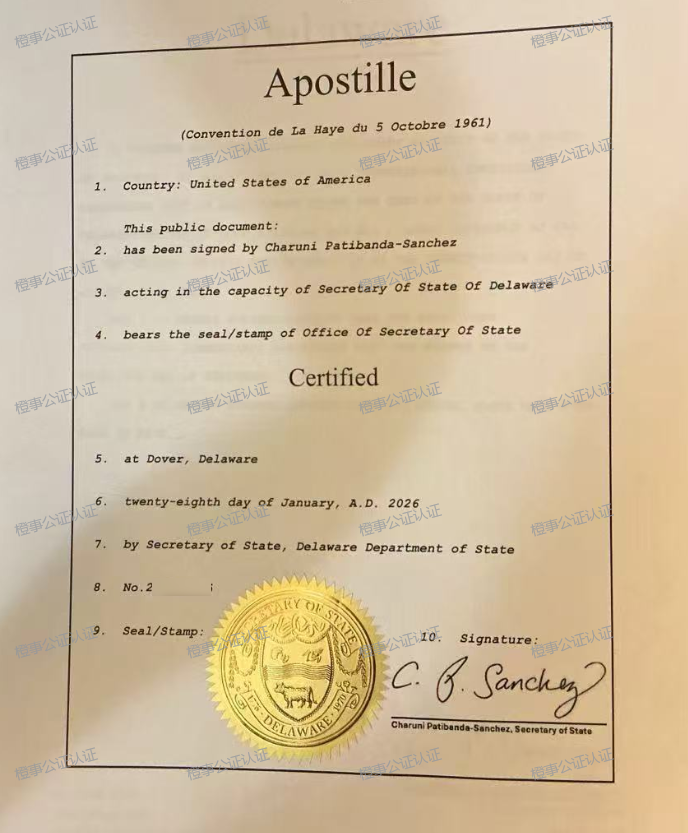
An apostille is a short document, and everything on it can be checked by eye. Read it against the Convention's model certificate:
- The heading reads Apostille (Convention de La Haye du 5 octobre 1961), in French, in that order.
- It carries a certificate number, the country of issue and the name of the authority that issued it — for Delaware, the Secretary of State, Division of Corporations.
- It names the person who signed the underlying document, the capacity in which they signed, and the seal or stamp that was applied.
- It is dated, numbered and signed, and the signature is that of an officer of the issuing authority.
- It is physically attached to the document it covers — usually by a seal or binding. A loose apostille is a warning sign.
If anything looks wrong, the issuing authority can confirm the certificate. And if you are checking whether the destination country is actually a party to the Convention — which is what makes the apostille valid at all — go to the HCCH status table rather than a directory site, since third-party lists lag behind status changes. Remember the limits as well: an apostille confirms the signature and seal, not the accuracy of the content, and the receiving authority can still apply its own standards to the document.
FAQ
1. Can a Delaware apostille be used in mainland China?
Yes. The Convention has applied to mainland China since 7 November 2023, so a single apostille on a Delaware public document is enough for use there. Note that documents moving between mainland China and Hong Kong or Macao do not use the Convention.
2. Do I still need the Chinese embassy or consulate to legalise it?
No. The apostille replaces consular legalisation. Consular legalisation only comes back into play when the destination country is not a party to the Convention — and in that case the Delaware certificate issued will be an authentication rather than an apostille, and it may have to go on to the US Department of State.
3. Can the Division of Corporations apostille a document from another state?
No. Out-of-state documents are refused, including documents notarized by a notary from another state, and they have to go to the state that issued or notarized them. Federal documents — including anything signed and sealed by a federal agency or a federal court — go to the US Department of State's Office of Authentications.
4. Do birth, marriage and death certificates need to be notarized first?
No. Delaware states that publicly recorded documents "are never notarized" and must be official copies of the issuing state or county official. What they need is the certified copy, not a notarization. Documents that do need notarization are powers of attorney, affidavits, translations, and diplomas or transcripts.
5. The official fee is only $30 — why does a service charge more?
The $30 is the Division's apostille fee and nothing else. It does not cover the certified copy, the notarization, the translation or the return shipping, and it does not cover the work of establishing which route applies and assembling the submission so it is not rejected. A service fee pays for that coordination and for the error-checking that goes with it.
6. Can I do this myself from outside the United States?
If your document is already an official certified copy and needs no notarization, mailing it in yourself is possible in theory — provided you can arrange payment and a prepaid return envelope. If the document needs notarization, or you still have to obtain the certified copy, or you were relying on a notarization done remotely, it is usually not something you can complete on your own from abroad.
Tell us the document type and the destination country and we will come back with the steps, the service fee and the timeline — free consultation, no charge and no follow-up pressure. Ask us a question →
Sources / last verified
- Delaware Secretary of State, Division of Corporations, “Certifications, Apostilles and Authentication of Documents”: the definitions of apostille, authentication, commercial use and non-commercial use, the accepted and refused document lists, the translation and dual-notarization rule, the separate-certification rule, the remote/electronic notarization exclusion, the “never notarized” rule for publicly recorded documents, the Notary Good Standing certificate and the discretionary refusal right — checked 16 October 2026.
- Division of Corporations, “Submitting Non-Commercial Documents for Apostille or Authentication”: the $30.00 simultaneous-submission fee, the $30.00 per document commercial fee, the mail and in-person submission routes, the appointment line (302) 739-3077, the cover-memo requirement and the return-envelope rule — checked 16 October 2026.
- Division of Corporations FAQ: the personal-use discount wording and the processing statements for mailed requests (same business day) and hand-delivered requests (within 2 hours) — checked 16 October 2026.
- Division of Corporations contact page and Expedited Services page: PO Box 898 regular mail address, 401 Federal Street express-mail and in-person address, operator hours 8:00am–4:30pm, appointment-only in-person assistance, return by fax or email not available, and the one-hour ($1,000.00), two-hour ($500.00), same-day ($100–$200) and next-day ($50–$100) expedite tiers — checked 16 October 2026.
- State of Delaware, “Certificates” guide: birth (1953 and earlier / 1954 to present), death (1985 and earlier / 1986 to present) and marriage (1975 and earlier / 1976 to present) record cut-offs, Public Archives (302) 744-5000 and Office of Vital Statistics (302) 744-4549, and the divorce decree offices by county — checked 16 October 2026.
- US Department of State, Office of Authentications: scope of federal documents and the $20 per document fee — checked 12 October 2026.
- HCCH, Apostille Convention status table: signed 5 October 1961, in force 24 January 1965, 130 Contracting Parties as of 30 June 2026.
Fees and timelines above are those published on the dates checked. Official charges change, so confirm against the authority's current page before quoting a figure to a client.

