




HOPEGOLD (SHENZHEN) BUSINESS MANAGEMENT CONSULTING CO.,LTD
Global professional notarization and certification service agency
Contact Us
Hotline: +86-755-28261216
Email: Bruce@hopegold.cn

Federal Apostille vs State Apostille: Which One Do You Need?
Federal Apostille vs State Apostille: Which One Do You Need?
A US apostille comes from one of two authorities. If a federal official signed the document — an FBI background check, a federal court order, a military record — it goes to the US Department of State at $20 per document. Everything else goes to the Secretary of State of the state that issued it, for $6 to $20. One question decides it: who signed the paper?
Who this guide is for
If you have a document in hand and cannot tell whether it is federal or state, you are in the right place. One question settles it, the two offices have completely different addresses and payment rules, and sending a document to the wrong one means it comes back untouched — and you do not get the fee refunded. Read Which authority handles it and the fees table, then go.
If you already know it is an FBI background check, a federal court record or a military document, skip straight to Documents that must go to the US Department of State. The $20 fee, the Sterling, VA mailing address and the 5-week mail timeline are all there.
If it is a birth, marriage or death certificate, a diploma, a notarized power of attorney or a state court judgment, a state office handles it. Each state sets its own fee and its own counter rules, so the table in Fees and processing time is where the answer is.
If you are filing from overseas — no US bank account, no US return label, no way to phone an office during Eastern Time business hours — the friction is real, but it is the payment and postage, not the apostille itself. Where overseas applicants get stuck lays out the four walls.
If it turns out to be more trouble than it is worth, you can Talk to us directly — you tell us the document and the destination country, and we take it from there.
What an apostille certifies — and the one question that decides federal or state
An apostille is the certificate created by the Hague Convention of 5 October 1961, in force since 24 January 1965. As of the HCCH status table updated 30 June 2026 there are 130 Contracting Parties. The United States acceded on 24 December 1980, and the Convention entered into force for the US on 15 October 1981. The apostille does one narrow job: it certifies the signature on the document, the capacity in which the signatory acted, and the seal or stamp the document carries. It does not certify that the contents are true, and it does not translate anything.
Because it certifies a signature, the authority that can issue it is the one that recognises the signer. That is the whole logic of the federal-versus-state split. A Secretary of State in Albany can vouch for a New York notary or a New York county clerk; it cannot vouch for an FBI official in Washington. Conversely, the US Department of State authenticates signatures of federal officials — it has no view of a town clerk in Ohio.
So the test is not what the document says, and not where you live. It is: who signed it? If the signature belongs to a federal official, a US consular officer, a foreign consul registered with the State Department's Office of Protocol, or a military notary or judge advocate, it is federal. Anything else — a state registrar, a county clerk, a notary public commissioned by a state — is state-level.
Which authority handles it: federal vs state at a glance
The two systems barely overlap. They use different addresses, different payment methods and different counters. Printing this table and ticking the column that matches your document is the fastest way to avoid a return.
| Comparison | Federal | State |
|---|---|---|
| Issuing authority | US Department of State, Office of Authentications | The Secretary of State of the issuing state |
| What it covers | FBI background checks, federal court and agency records, military records, documents signed by federal, consular or military officials | Birth, marriage and death certificates, diplomas, notarized powers of attorney, state court records, corporate filings |
| Where you send it | Mail: 44132 Mercure Cir., PO Box 1206, Sterling, VA 20166-1206 In person: 600 19th Street NW, Washington, DC 20006 |
The Secretary of State office in the state that issued the document (see the fees table) |
| Official fee | $20 per document (non-refundable) | Set by each state: $6 to $20 per document |
| Processing time | Mail: within 5 weeks of receipt. Walk-in: 7 business days | Mail: in order received, often 2–3 weeks. Many states do same-day at the counter |
| How you pay | Mail: cheque or money order only. In person: card or contactless only | Varies by state — cheque, money order or card; check the state's page |
One authority sits outside both columns. The District of Columbia is not a state, so DC documents are apostilled by the DC Office of Notary Commissions and Authentications at 899 North Capitol Street, NE, Suite 8100, Washington, DC 20002 — not by a Secretary of State and not by the Department of State.
Documents required: what each level will and will not accept
The Department of State accepts four categories of signatory and nothing else: a US federal official, a US consular officer, a foreign consul registered with the Office of Protocol, or a military notary or judge advocate. If the signature on your document is not one of those four, the federal office is the wrong door.
Both levels share three physical requirements. The document must be an original or a certified copy — a plain photocopy is refused. The signature and the seal or stamp must be original, not reproduced. And the document must carry an issuance date. Beyond that, the federal office asks for a clear signature, the signer's printed name and title, the agency seal and agency letterhead; a state office asks that the underlying signature come from a notary, a county clerk or a registrar it recognises.
Three state-level rules carry across the country and are worth memorising:
- A Secretary of State authenticates only documents issued in its own state. New York puts it plainly: “The Department of State only authenticates public documents issued in New York State which are signed by a New York State official or county clerk.” Massachusetts is blunter still: “Massachusetts does not certify out-of-state documents.” An out-of-state document has to go back to the state that issued it.
- Birth, death and marriage certificates issued by a city, county or local registrar usually need a county clerk certification first. A certificate signed by the state registrar directly often does not.
- Photocopied signatures are not accepted. Florida's rule is that an original certified copy is required and “a photocopy is not acceptable”.

Fees and processing time (official figures)
Every figure below is taken from the issuing authority's own page and checked 12 October 2026. “Per document” means per document, not per page. Federal fees and state fees are separate charges paid to separate offices — if you have both kinds of document, you will pay both.
| Issuing authority | Official fee | Processing time |
|---|---|---|
| Federal — US Department of State, Office of Authentications | $20 per document | Mail within 5 weeks of receipt; walk-in 7 business days |
| New York — Department of State, Division of Licensing Services | $10 per document | Mail in order received; walk-in same day, limit 10 documents |
| California — Secretary of State, Notary Public Section | $20 per document; at the counter an extra $6 per different public official signature | In order received; no expedite service. Sacramento and Los Angeles counters are same-day |
| Texas — Secretary of State, Authentications Unit | $15 per document (per document, not per page) | Mail about 2 weeks; walk-in limit 10; certified records must be issued within 5 years |
| Florida — Department of State, Division of Corporations | $10 per document; $20 if the document was certified by a county clerk | In order received; no expedite service |
| Massachusetts — Secretary of the Commonwealth, Commissions Section | $6.00 per document | Mail 2–3 weeks; counter limit 3 same-day, 4 or more collected next day after 15:00 |
| District of Columbia — Office of Notary Commissions and Authentications | $15 per document | Mail 5 business days; walk-in same day |
Timing depends on how you file, not on which office. At the federal level there are three tracks. Mail is processed within 5 weeks of receipt. The walk-in window is Monday to Thursday, 7:30–9:00, with documents ready in 7 business days; you may submit one application per day and no more than 15 documents per customer or company. An appointment is reserved for genuine emergencies — a death, imminent death or critical illness of an immediate family member abroad within two weeks — and is completed the same day. At the state level the pattern is “queue by mail, same day at the counter”, but almost every state caps how many documents it will take across the counter at once.
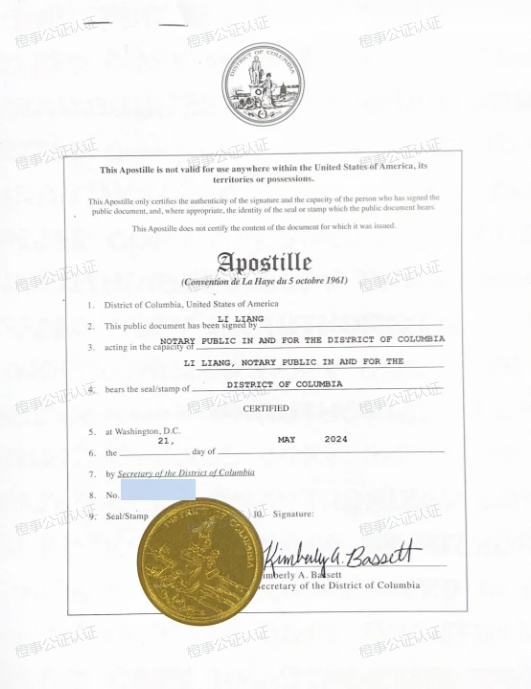
Step by step: how the apostille is actually obtained
Get the order wrong and the fee is not refunded; you lose the postage and the time as well.
- Step 1. Confirm the destination country is a Contracting Party, and ask the receiving body whether it wants an original or a certified copy, and whether it wants a translation.
- Step 2. Identify the signatory. Federal official, consular officer, registered foreign consul or military notary → the Department of State. Anyone else → the state. Do not mail to both “just in case”.
- Step 3. Assemble the document. If you need a certified copy, order it from the issuing agency; if a county clerk certification is required, collect that first.
- Step 4. File it. Federal mail filings need Form DS-4194 stating the destination country, plus a self-addressed stamped envelope (USPS or UPS).
- Step 5. Translate if required, deliver to the receiving body, and keep the apostille number so the certificate can be verified later.
The step most applicants miss: never notarize a federal document
This is the trap, and it runs in the opposite direction at each level. A state document usually needs a notarization first — a power of attorney or an affidavit is signed in front of a notary, and the Secretary of State then authenticates the notary's signature. A federal document is the reverse: the FBI official who signed the background check is the signatory, and the Department of State authenticates that signature directly.
The Department of State states the consequence without hedging: “Do not notarize your document. Your document will no longer be valid if it is notarized.” Add a notarial block to an FBI background check and it is void on the spot. The fee, the postage and the weeks of waiting all restart from a new document.
The same section catches translations. If the destination country requires a translation, the correct sequence is to have a professional translator produce it and then notarize the translation — not the original document. Notarizing the original is the mistake; notarizing the translation is fine.
Mail or walk in
If you are in the United States and can reach a counter, walking in is almost always faster — and the two levels accept opposite payment methods, which is where people get caught out.
| Channel | Federal (Department of State) | State (Secretary of State) |
|---|---|---|
| By mail | Cheque or money order payable to “U.S. Department of State”, with your name and address printed top-left and a cheque number above 100. No cash, no card details. | Varies: most states take a cheque or money order; some also accept card or an online account. Check the state's page. |
| In person | Credit or debit card, or Apple Pay / Google Pay / Samsung Pay only. No cash, no cheque, no money order. | Usually card or cash at the counter; California's Los Angeles office, for example, does not take cash. |
| Return of documents | You supply a self-addressed stamped envelope or a prepaid courier label. | Generally you supply a self-addressed envelope; some states require a prepaid air bill. |
The counter is also where the caps bite. The federal walk-in desk takes one application per day and 15 documents per customer; New York and Texas cap same-day counter service at 10 documents; Massachusetts will only hand back 3 on the spot and makes you collect anything beyond that the next business day. Plan the batch size before you travel.
Where overseas applicants get stuck
The apostille is not the hard part for someone filing from abroad. Four practical walls are, and they are the same four every time.
- Payment is limited to US dollar instruments. Federal mail filings accept only a cheque or money order drawn on a US institution. A state office such as Florida says outright that it does not accept cash or credit cards. Without a US bank account, paying the fee becomes the first obstacle.
- Return postage has to be arranged in advance. You need a self-addressed stamped envelope or a prepaid air bill with your own address in both the sender and recipient fields. Federal filings will not accept a collect or bill-to-recipient label.
- There is no expedite tier to buy. California and Florida both process mail strictly in the order received, and neither sells a faster service. The only real lever is the counter — which requires someone physically in that state.
- Business hours run on local time. The federal walk-in window is 7:30–9:00 Eastern, and state call centres keep state business hours. From a different time zone, a phone call alone can take a day of planning.
None of these are about the document. They are about having a US payment instrument, a US return label and someone on the ground during office hours. That combination is what most overseas applicants are actually short of.
Cost breakdown
An apostilled document costs more than the government fee, because at least three parties are paid along the way and none of them collects for the others.
| Cost segment | What it covers | Paid to |
|---|---|---|
| Government fee | The $6–$20 state apostille or the $20 federal apostille; California's extra $6 per official signature at the counter | The issuing authority |
| Your own costs | Notary fee, county clerk certification, replacement certified copies, translation, courier and return postage | Notary, issuing agency, translator, courier |
| Service fee | Quoted per document type, number of copies and destination (path check, missing prerequisite steps, filing, collection and follow-up). Get a quote → | The service provider |
To judge whether a quote is reasonable, ask one question: how much of it is the government fee, and is that fee passed through at cost or marked up? A provider who quotes only a lump sum, with the official fee hidden inside, has usually folded in steps the document never needed.
When to use a service
Plenty of people can do this themselves: one document, a clear destination, and you are already in the issuing state. The six situations below are where self-filing stops being cheaper once you count your own time.
- You are not in the United States and have no reliable contact who can file, pay, collect and chase.
- Payment is restricted to a cheque or money order drawn on a US bank — a wall in itself from abroad.
- The document needs a county clerk certification first, or a certified copy you have to reorder from the issuing agency.
- Your batch mixes federal and state documents, which means two offices and two sets of payment rules.
- The destination country may change, so you need the apostille-versus-consular-legalization call made before you file.
- You would rather reduce the risk of a return than save the fee on a filing that comes back.
Common rejection reasons
A returned document does not come with a refunded fee. These five cases account for most of them, and all five are checkable before you post anything.
| Reason | What it looks like | How to avoid it |
|---|---|---|
| Wrong office | An FBI background check mailed to a Secretary of State, or a birth certificate mailed to the Department of State | Identify the signatory first |
| Federal document notarized | A notarial block added out of habit — the document is void immediately | Send federal documents straight in; notarize only the translation |
| Missing prerequisite certification | A locally issued certificate that never went through the county clerk | Complete the earlier step before filing |
| Payment refused | Cash or card details in a mail filing; a cheque not drawn on a US bank | Prepare the mail and counter payments separately |
| Photocopy or missing return envelope | A plain copy instead of an original or certified copy; no stamped return envelope | Use the original or a certified copy and tick every item before posting |
If one of those looks like your file, send us the document type and the destination country and we will separate the government fee from the service fee in writing first. Contact us →
How to verify authenticity
- New York: apostilles issued on or after 9 April 2013 can be checked in the Department of State's online system; older ones require a phone call to the office.
- Massachusetts: there is no online lookup. Verification rests on the fact that a single authority issues them, plus comparison of the notary's commission details.
- Federal: the Department of State issues a numbered, sealed one-page certificate; the number is the handle for checking it.
- Any authority: compare the certificate number, the issuing office and the identity of the signer. An apostille certifies only the signature, the signatory's capacity and the seal — not the content of the document — and the receiving country keeps the right to accept or reject it on its own terms.
FAQ
1. My birth certificate is from Texas. Federal or state?
State. A birth certificate is signed by a state or local registrar, not a federal official, so it goes to the Texas Secretary of State's Authentications Unit at $15 per document. The Department of State has no authority over it.
2. Can a state Secretary of State apostille my FBI background check?
No. An FBI background check is issued by a federal agency and must go to the US Department of State, Office of Authentications, at $20 per document. The District of Columbia's own “not accepted” list names FBI background checks and FBI Clearance Letters explicitly and routes them to the Department of State.
3. Why is the same document priced differently in different states?
Because some documents need an extra prerequisite certification that carries its own fee. Florida is the clearest case: a routine document is $10, but one that has been certified by a county clerk is $20 — the extra $10 is the Certificate of Incumbency, not a rush fee.
4. I have both a federal and a state document. Can I send them together?
No — they go to two different offices with two different payment rules. The federal document goes to Sterling, VA; the state document goes to the issuing state's Secretary of State. Send them separately, and note that the federal walk-in desk caps you at 15 documents per customer.
5. The government fee is only $20. Why would I pay a service fee?
The government fee covers one action: issuing the certificate. The service fee covers everything before it — deciding federal or state, completing a missing county clerk step, splitting a batch around the per-visit caps, preparing a payment instrument and return envelope that the office will actually accept, and following up if it comes back.
6. Can I do this myself?
Yes, when the document is straightforward, the signatory is clear, you are in the United States and you have already confirmed what the receiving body wants. What stops most people is not the process but the payment restriction — a US cheque or money order — and the need for someone to appear at the counter.
7. Does my document need a translation?
Only if the receiving body asks for one. An apostille does not translate anything. When a translation is required, have a professional translator produce it and then notarize the translation — never the original federal document.
Sources and last verified
Authorities, addresses, fees and timelines in this article are taken from the following public sources, checked 12 October 2026:
- US Department of State, Office of Authentications (travel.state.gov) — addresses, $20 per document, payment rules, the 5-week and 7-business-day timelines, the 15-document cap, the four accepted signatory categories and the prohibition on notarizing federal documents.
- DC Office of Notary Commissions and Authentications (os.dc.gov) — $15 per document, 5 business days by mail and same-day in person, and the list of documents it will not accept, including FBI background checks.
- The Secretaries of State of New York, California, Texas, Florida and Massachusetts — each state's fee, prerequisite certifications, counter limits and processing time.
- HCCH, Convention of 5 October 1961 (Apostille Convention) status table, updated 30 June 2026 — the Convention signed 5 October 1961, in force 24 January 1965, with 130 Contracting Parties; the United States acceded 24 December 1980, in force 15 October 1981.
Official fees and processing times change. Confirm the current figures with the issuing authority on the day you file.
We will answer three things first: whether the document goes to the federal office or to a state, which prerequisite certification is missing, and what the government fee and the service fee are separately — then send you the steps and the timeline in one reply. Free to ask, no pressure to proceed. Ask us a question →

