




HOPEGOLD (SHENZHEN) BUSINESS MANAGEMENT CONSULTING CO.,LTD
Global professional notarization and certification service agency
Contact Us
Hotline: +86-755-28261216
Email: Bruce@hopegold.cn

FBI Background Check Apostille: Complete Guide for Federal Documents
FBI Background Check Apostille: Complete Guide for Federal Documents
An FBI background check is a federal document, so exactly one office can apostille it: the U.S. Department of State Office of Authentications, at $20 per document. The FBI issues the report itself for $18. Two offices, two fees, and the FBI will not forward your report to the State Department on your behalf.
You have an FBI Identity History Summary in hand, or you are about to order one, and someone outside the United States has asked for it to be legalised. That covers visa and residence applications, work authorisation, adoption files, professional registration, and the many immigration streams that name an FBI check specifically.
You can handle this yourself if you are in the United States, can buy a U.S. money order, and can post a package with a return envelope. If any of those three is missing, the process gets harder than the two fees suggest. If you would rather not manage the postage chain, talk to us directly and we will tell you what your route looks like.
What an FBI Background Check Apostille Actually Is
The FBI calls the document an Identity History Summary. Everyone else calls it a rap sheet. It lists information drawn from fingerprint submissions held by the FBI, and where applicable federal employment, naturalisation or military service entries. If you have no arrest data on file, you do not get a blank result: the FBI sends a letter stating that no prior arrest data exists, and that letter is the document that gets apostilled.
The apostille is a separate certificate, stapled or glued to the report. Under Article 3 of the 1961 Hague Convention it certifies three things only: the authenticity of the signature, the capacity of the person who signed, and where appropriate the identity of the seal or stamp. It does not certify that the report is accurate, complete, or favourable to you. Receiving authorities know this, which is why they sometimes ask for the report to be recent as well.
This matters because the FBI no longer seals the report the way it used to. From the FBI's own FAQ:
"The FBI no longer places the FBI seal on U.S. Department of Justice Order 556-73 fingerprint search results. The FBI authenticates all fingerprint search results by placing the FBI watermark and the signature of a division official on the results at the time of submission."
So the apostille is not decoration on top of an already-sealed document. It is the step that turns a signature into something a foreign ministry will accept.
The document you have decides the office you use
| What you are holding | Who issued it | Who can apostille it |
|---|---|---|
| FBI Identity History Summary (rap sheet) | FBI Criminal Justice Information Services Division, Clarksburg, WV | U.S. Department of State, Office of Authentications, Washington, DC |
| FBI "no record" letter | FBI Criminal Justice Information Services Division | U.S. Department of State, Office of Authentications |
| State police or state bureau clearance | A state law enforcement agency | That state's Secretary of State, not Washington |
| Local police clearance | A city or county police department | Usually notarised first, then sent to that state's Secretary of State |
| Federal court order or other federal agency record | A federal agency or federal court | U.S. Department of State, Office of Authentications |
One line on the FBI's page deserves careful reading: "Identity History Summaries are not to be used for employment or licensing." That sentence is about domestic U.S. screening, and the FBI points American employers to state identification bureaus instead. It does not stop a foreign immigration authority from asking for the Identity History Summary, which is the document most of them name. If your recipient asked for an "FBI check", this is what they mean.
Which Authority Handles It: Two Offices, Two Addresses
The single most common mistake is sending a federal report to a state office. A state Secretary of State authenticates signatures of state officials. It has no authority over an FBI signature, and a package sent to the wrong capital comes back with the fee spent. The rule is mechanical: read who signed the document, and follow that signature.
| Office | What it does | Address | Contact |
|---|---|---|---|
| FBI CJIS Division – Summary Request | Issues the Identity History Summary | 1000 Custer Hollow Road, Clarksburg, WV 26306 | identity@fbi.gov · (304) 625-5590 |
| U.S. Department of State, Office of Authentications (postal) | Issues the apostille or authentication certificate | 44132 Mercure Circle, PO Box 1206, Sterling, VA 20166-1206 | Contact Us form on travel.state.gov |
| U.S. Department of State, Office of Authentications (counter) | Accepts walk-in drop-off and pick-up | 600 19th Street NW, Washington, DC 20006 | Walk-in window 7:30–9:00 a.m., Monday to Thursday |
The State Department draws the line for you on its own requirements page. An apostille is for a document you will use in a country inside the 1961 Hague Convention. If the destination is not a party, you get an authentication certificate instead, and the destination's embassy in Washington will usually want to legalise that certificate afterwards. Same office, same fee, different piece of paper, and one more stop.
Four categories of signature qualify: a U.S. federal official, a U.S. consular officer, a foreign consul registered with the State Department's Office of Protocol, and a military notary or judge advocate. An FBI division official sits in the first category. That is the whole basis on which the Office of Authentications will touch your report.
Documents Required at Each Stage
For the FBI request itself you need three things and nothing else:
- A completed applicant information form. Each person in a family request signs a separate form.
- A current fingerprint card. The FBI accepts its own FD-1164 on standard white card stock, or the card your fingerprinting agency supplies. It must be a current card, not one that has been processed before.
- Payment of $18 per person by credit card, money order or certified check.
The fingerprint card has requirements that quietly sink applications. You need rolled impressions of all ten fingers and a second set taken flat at the same time. Your name, date of birth and signature go on the card. Ink or live scan is fine, but a live scan has to be printed onto a card, because the FBI wants paper. The FBI recommends a trained technician, and warns that illegible prints are rejected, which delays the request and can cost more.
Two things you should not send, both stated plainly by the FBI: no self-addressed envelope, and no request to forward the result anywhere. Fingerprint cards are also never returned. If you need a second sealed original for a second recipient, that is a second request and another $18. Copies of your one original are fine for your own files, but a photocopy is not an original.
For the State Department stage, the package changes:
- Form DS-4194, with the country of use written on it. A form that leaves the country blank is the quietest way to lose five weeks.
- The original report, with original seals and signatures and a visible date of issue.
- $20 per document, paid by the method that matches your channel.
- A self-addressed, prepaid return envelope with USPS or UPS postage or an air bill already on it. The State Department asks you not to use FedEx on the return envelope.
Fees and Processing Time: The Official Figures
Both offices publish their numbers, and neither sells speed to an individual. What follows is taken from the FBI's Identity History Summary pages and the State Department's Office of Authentications pages, checked on 28 October 2026.
| Stage | Office | Official fee | Published time | What starts the clock |
|---|---|---|---|---|
| Identity History Summary, ordered online | FBI CJIS | $18 per person | Within 48 hours of electronic fingerprints at a participating U.S. Post Office | The fingerprint visit |
| Identity History Summary, online order with a mailed card | FBI CJIS | $18 per person | Approximately 10 days | The FBI receiving your fingerprint card |
| Identity History Summary, mail request | FBI CJIS | $18 per person | Up to 15 days, plus mail delivery time | The FBI receiving your package |
| Apostille by post | State Department, Office of Authentications | $20 per document | Within five weeks of receipt | The package arriving in Washington, DC |
| Apostille at the counter | State Department, Office of Authentications | $20 per document | Seven business days | Your drop-off between 7:30 and 9:00 a.m. |
Add the two published times together and you get the honest answer for a postal route: roughly eight to ten weeks from the day you post your fingerprints to the day the apostilled report comes back. The FBI is the faster half. The five-week figure at the State Department is the one that decides whether you make a deadline, and it does not move because you are in a hurry.
Neither office offers paid expediting to an individual. The FBI says it outright: "You cannot pay extra for faster service," and separately, "The FBI does not expedite requests; however, the request should be processed faster if it is submitted electronically." The State Department's only fast lane is physical: walk the document in and collect it seven business days later. The same-day appointment exists, but only for a death or a life-threatening illness in your immediate family abroad, and it requires proof.
Step by Step: From Fingerprints to Apostille
- Ask the recipient what they want. Which document, how recent, whether they need the apostille itself or just the report, and whether they need a translation. This one conversation prevents most reprints.
- Order the summary. Online at edo.cjis.gov is the faster route. By post it is the applicant information form, the fingerprint card and $18 to Clarksburg, West Virginia.
- Get fingerprinted. A participating U.S. Post Office takes electronic prints if you ordered online; otherwise a police department, sheriff's office or private fingerprinting company can roll ink prints onto the card.
- Pay the FBI $18. Credit card on the FBI's payment form, or a money order or certified check payable to the Treasury of the United States. Cash, personal checks and business checks are destroyed, not returned.
- Wait for first-class mail. The FBI returns results by U.S. Postal Service first-class mail, domestic and foreign, with no tracking and no courier option. If you ordered online, choose the mailed hard copy as well as the electronic one.
- Scan the report before you send it anywhere. The certificate is fixed to the report when it is issued, so take a clean scan first, and if a translation is needed, have it made from that scan.
- Build the State Department package. DS-4194 with the country named, the original, $20, and the prepaid return envelope.
- Choose your channel. Post it to Sterling, Virginia, and wait five weeks, or hand it in at 600 19th Street NW between 7:30 and 9:00 a.m. and collect it seven business days later.
- Check the certificate before you courier it abroad. Country of use, your name as it appears on the report, and the number on the certificate.
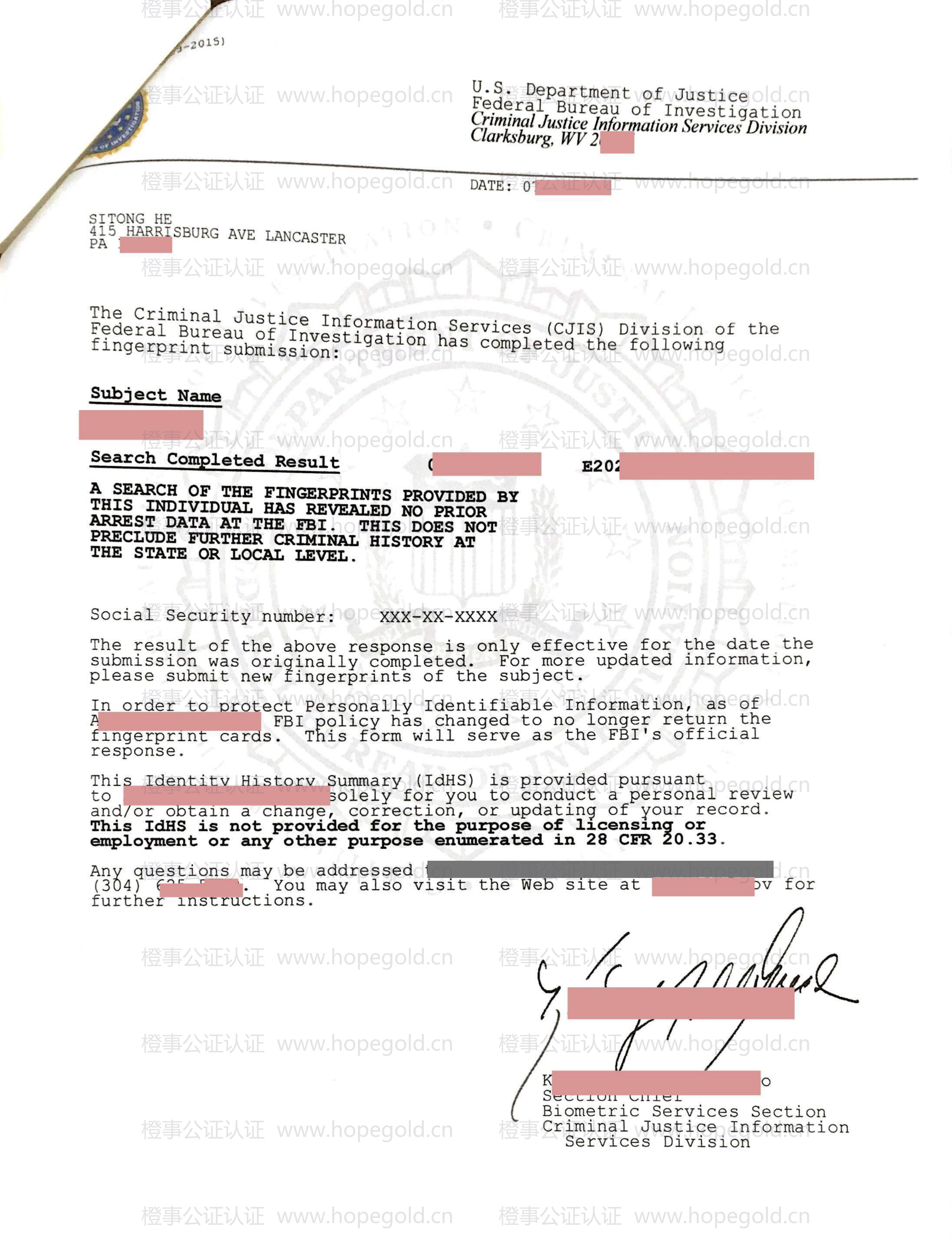
A redacted FBI Identity History Summary of the kind the Office of Authentications apostilles. Note the DOJ and FBI letterhead, the division official's signature and printed title at the foot, and the absence of a raised seal.
The Step Most People Miss
Four details decide whether this goes smoothly, and none of them appears on the checklist most people are working from.
The FBI will not forward your report to the State Department
"Do not send a self-addressed envelope. This includes pre-paid Priority Mail, FedEx account numbers, UPS, foreign postage coupons, and requests to forward correspondence to the Department of State for the apostille process."
That sentence closes a shortcut a lot of people assume exists. The report comes back to you, or to whoever you named, and then travels to Washington as a separate package with its own postage. Budget one to two extra weeks and two postal legs, and do not write "please forward to the State Department" on the envelope, because that request is exactly what the FBI declines.
Do not notarise the report
"Do not notarize your document. Your document will no longer be valid if it is notarized."
This is where habits from state-level documents do damage. A notarised power of attorney goes to a Secretary of State; a notarised FBI report is a dead document at the federal counter. If the destination needs a translation, the State Department's instruction is to have a professional translator do it and have the translation notarised, never the original.
It is no longer printed on blue security paper
"The FBI does not provide Identity History Summary results on blue security paper (due to an automation process). All responses will be processed on standard white paper."
Plenty of checklists, including some published by embassies, still describe a blue-paper report. If a clerk queries your white one, the FBI FAQ is the answer, not a reprint. What replaces the security paper is the FBI watermark plus the signature of a division official.
The five-week clock starts in Washington, not in Virginia
"You will not receive an update when the package arrives up to several days later at our office in Washington, D.C. Your processing times begin when we receive the package in Washington, D.C."
The mailing address is a Sterling, Virginia post office box. Tracking will show delivery there and then go quiet for several days while the package moves to the District. If you are counting weeks against a visa appointment, add that gap rather than assuming day one is the day tracking says "delivered".
Mail or Walk-In at the Office of Authentications
The two channels are not interchangeable, because the payment rules are opposites. Choose before you assemble the package, not after.
| By post | At the counter | |
|---|---|---|
| Where | 44132 Mercure Circle, PO Box 1206, Sterling, VA 20166-1206 | 600 19th Street NW, Washington, DC 20006 |
| Window | Any time, by carrier | Drop-off and pick-up 7:30–9:00 a.m., Monday to Thursday only |
| Paying the $20 | Check or money order to "U.S. Department of State". Preprinted name and address on the check, and every check number must be over 100. No cash, no card details. | Credit card, debit card or contactless (Apple Pay, Google Pay, Samsung Pay). No cash, check or money order. |
| Volume limit | None stated | One request per day, up to 15 documents for one customer or company |
| Published time | Within five weeks of receipt | Seven business days |
| Getting it back | Self-addressed prepaid envelope, USPS or UPS, not FedEx | You collect it in person |
| Fees refundable | No. Federal law bars refunding the authentications fee. | No. Same rule. |
Two practical notes on the counter route. First, it is two trips: one to drop off inside the morning window and one to collect seven business days later. Second, the office works on Fridays but takes no walk-ins and holds no appointments that day, so both trips have to fall between Monday and Thursday.
Where Overseas Applicants Get Stuck
Everything above is routine if you live in the United States. Applied from abroad, the same two offices produce four walls, and each one costs time rather than money.
- U.S. payment instruments. The FBI takes a credit card, so that wall is low. The State Department by post does not: it wants a check or money order payable to the U.S. Department of State, with the payer's name and address preprinted and a check number above 100, and it refuses cash and card details outright. Sourcing a U.S.-dollar instrument of that exact shape from outside the country is the real obstacle.
- Fingerprints without a U.S. police department. You can be printed abroad and post the card, and the FBI explicitly allows a mailed card from outside the United States. The difficulty is quality: smudged or partial prints get rejected, and a rejection restarts the wait. Have two sets taken and send both.
- U.S. return postage. The State Department requires a self-addressed prepaid envelope with USPS or UPS postage already attached, and it will not use FedEx on the return. Postage cannot be bought abroad, so this usually means a contact in the United States or a courier account arranged in advance.
- No tracking, no courier, no expedite. The FBI returns results by first-class mail only. There is no tracking number and no overnight option, which makes a lost report a reorder rather than a trace. Order the electronic copy as well so you at least hold the content while the paper original is in transit.
If the destination is not a party to the 1961 Convention, add a fifth step: the authentication certificate has to go to that country's embassy in Washington for legalisation before it is useful. That embassy sets its own fee and its own turnaround, and neither is published in one place.
Cost Breakdown
The official fees are small and fixed. Everything that varies sits around them, which is why a quote that only names $38 is not a quote.
| Line | Who is paid | Amount |
|---|---|---|
| FBI Identity History Summary | FBI, per person | $18.00 (official, fixed) |
| Fingerprinting | Post Office, police department or private technician, if charged | Set by the provider; no FBI fee beyond the $18 |
| Apostille or authentication certificate | U.S. Department of State, per document | $20.00 (official, non-refundable) |
| Postage and courier | Carriers | At cost: outbound to West Virginia, outbound to Virginia, prepaid return |
| Certified translation, if required | Translator | At cost, per language and per page |
| Extra sealed originals for other recipients | FBI | $18.00 each, as a separate request |
| Agency service fee | 橙事公证认证 | Quoted per document type, number of copies and destination. Get a quote → |
The pattern worth noticing is that the official side is $38 per person for one document, and the unpredictable side is postage, translation and reprints. A reprint because a fingerprint card was rejected, or because the report was notarised, costs another $18 and another two to three weeks. That is the real price of a small mistake here.
When to Use a Service
Most people can complete this themselves. The case for help is about risk and calendar, not about access. It is worth handing over if any of the following is true:
- You are outside the United States and cannot buy a U.S. money order or U.S. return postage.
- Your deadline is under ten weeks and the postal route will not fit, so the counter route in Washington is the only option and you are not in Washington.
- You need more than one sealed original, or the same report for two different destinations with different legalisation chains.
- The destination is not a Hague party, so the chain continues to an embassy after the State Department and you would rather not sequence that yourself.
- The recipient wants a translation, a specific validity window, or a certified copy of the apostille, and you want the order of operations checked before anything is spent.
- You want to reduce the risk of a rejection, because a rejection here costs weeks rather than a fee.
Common Rejection Reasons
These are the failures that actually recur, in rough order of frequency. Every one of them is cheaper to prevent than to fix.
- The original was notarised. The State Department's wording is unambiguous: the document is no longer valid once notarised. Order a new summary.
- A photocopy or a PDF was submitted. The office needs the original or a certified copy with original seals and signatures. A scan emailed by a channeler is neither.
- The report had already been processed. The FBI states that requests to authenticate previously processed results will not be accepted, so a re-used report has to be reordered.
- The payment instrument was wrong. Cash, a personal check, a business check, or card details written on a mailed form. By post it must be a check or money order above number 100 with a preprinted name and address.
- Form DS-4194 arrived without the country of use. The form asks for it because the office issues either an apostille or an authentication certificate depending on the answer.
- The return envelope was unusable. No postage, not self-addressed, or a FedEx label where USPS or UPS is required.
- The fingerprints were rejected. Usually too little ink, too much ink, or a partial thumb. The card is not returned, so the reprint starts from scratch.
- The report was too old for the recipient. The apostille does not expire, but the receiving authority can insist on a recent report, and several do.
If you want a second pair of eyes on the package before it goes out, contact us with the document type and the destination, and we will tell you what is likely to be queried.
How to Verify Authenticity
Verification for a federal apostille runs from the document outwards rather than from a public database, because the certificate is checked against the issuing office and the signatory.
- The apostille certificate itself. A numbered certificate, attached to the report, naming the country of use, the signatory, the capacity and the date. Check that the name and country are right before the document leaves your hands.
- The FBI's own authentication marks. The watermark, plus the signature of a division official with a printed name and title. Current reports carry no raised seal, only those two elements and the agency letterhead.
- The issuing office. The State Department answers status questions through its Contact Us form for authentications, and asks you not to submit a second request while you are waiting for a reply.
- The receiving authority. Some will contact the Office of Authentications directly. If yours offers that service, ask them to, because it settles the question faster than any document you can produce.
- The translation. If a translation travelled with the report, the translator's certification and notarisation should be checkable independently of the apostille.
FAQ
Can I apostille a scanned or emailed FBI report?
No. The Office of Authentications needs the original report with original seals and signatures, or a certified copy. An electronic result from a channeler or from the FBI's online system is useful for reading, but it is not the paper the apostille is attached to. If you ordered online, ask for the mailed hard copy as well.
Do I need to notarise the FBI report first?
No, and doing so invalidates it. Federal documents are apostilled directly on the federal official's signature. If the destination wants a translation, the translation is what gets notarised, not the report.
How long is an FBI background check valid?
The report is a snapshot of the record on the day the search completed, and the FBI notes that the result is only effective for the date the submission was originally completed. The apostille does not add an expiry date. What matters is the window your recipient sets, so ask them before you order rather than after.
Can the FBI send my report straight to the State Department?
No. The FBI explicitly declines requests to forward correspondence to the Department of State for the apostille process, and does not accept a self-addressed envelope. The report comes back to you and you send it on.
Should I use an FBI-approved channeler?
A channeler can be convenient for getting the check itself, and it collects its own fee on top of the $18. Its result is electronic, and channelers may only process requests for U.S. citizens or lawful permanent residents located in the United States or its territories, and not for employment or licensing. If the report is going to be apostilled, order through the FBI directly and take the mailed hard copy.
What if I have no criminal record at all?
You still receive a document: a letter confirming that no prior arrest data is on file with the FBI. That letter is apostilled in exactly the same way, and it is what most recipients actually want to see.
What does the whole thing cost?
$18 to the FBI and $20 to the State Department, per person and per document. Add fingerprinting if your provider charges, two or three postage legs, and a translation if the destination requires one. The official side is fixed; the rest is not.
The official fees are only $38, so why would anyone pay a service?
Because the fees are the small part. The cost of this process is the eight to ten weeks, the two postal legs, the U.S. payment instruments, and the fact that one notarised original means ordering again. A service buys sequencing and a check before anything is posted. You are welcome to do it yourself; the steps above are complete.
Tell us what the recipient asked for, which country it is going to, and when you need it. We will come back with the route, the realistic date, and the cost of handling it, with no obligation and no follow-up calls. Ask us a question.
Sources / last verified
FBI, Identity History Summary Checks (Rap Sheets) and Identity History Summary Checks Frequently Asked Questions (fbi.gov), including the $18 fee, the Clarksburg mailing address, the fingerprint card rules, the no-forwarding instruction, the blue security paper statement and the apostille FAQ. U.S. Department of State, Office of Authentications, Requesting Authentication Services and Preparing a Document for an Apostille Certificate (travel.state.gov), including the $20 fee, both addresses, the five-week and seven-business-day times, the payment methods for each channel, the DS-4194 requirement and the do-not-notarise rule. Hague Convention of 5 October 1961, Article 3, for the scope of what an apostille certifies. All pages checked on 28 October 2026.

