




HOPEGOLD (SHENZHEN) BUSINESS MANAGEMENT CONSULTING CO.,LTD
Global professional notarization and certification service agency
Contact Us
Hotline: +86-755-28261216
Email: Bruce@hopegold.cn

How Long Does an Apostille Take? Real Timelines and How to Read a Processing Table
How Long Does an Apostille Take? Real Timelines and How to Read a Processing Table
An apostille takes one business day to 25 working days depending on who issues it. Georgia and Hong Kong turn one around in two working days; the UK Legalisation Office quotes up to 25. In practice the certificate is rarely the slow part — getting a certified copy of the record usually is. Every figure below was read from the issuing authority’s own page on 23 October 2026.
- You have a deadline — a visa appointment, a court date, a university enrolment — and need to know whether the certificate can arrive in time.
- Someone told you it takes two weeks and you have already been waiting five.
- You are outside the issuing country and want to know which part of the chain is actually eating the calendar.
- You are deciding between posting documents and paying someone to walk them into a counter.
Tell us the document type, the country of use and your deadline, and we will come back with the realistic timeline and the step that is most likely to slip — free consultation, no charge and no follow-up pressure. Talk to us directly.
1. What “how long” actually measures
Almost every complaint about apostille timing comes from comparing two different things. The authority publishes one number: how long it takes to attach the certificate. The applicant experiences four stages, and only the third one is on that page.
| Stage | Who does the work | Realistic range | What usually goes wrong |
|---|---|---|---|
| 1. Obtain the record | Vital records office, court, school registrar, or the company registry | Same day at a counter, to 10 weeks by mail | Ordering a plain copy instead of a certified one, or ordering online and receiving an abstract |
| 2. Notarise, if required | A notary public in the issuing state or country | Minutes, or a few days to find one | Notarial wording missing, or a signature that does not match the commission record |
| 3. Apostille | The competent authority — state Secretary of State, GSCCCA, ONCA, High Court, FCDO | 2 working days to 25 working days, or 30 minutes at a counter | Sending a federal document to a state office, or an out-of-state document to the wrong state |
| 4. Return delivery | Postal service or courier | 1–3 days domestically, 1–2 weeks internationally | No prepaid return label, so the file comes back by ordinary untracked mail |
Read a quoted timeline as a claim about stage 3 only. If someone tells you “two weeks” and you are still waiting after five, the missing weeks are almost always in stage 1 or stage 4.
2. Published turnaround times, authority by authority
These are the numbers the offices publish themselves, not averages. Where an authority refuses to publish a number and simply works in order of receipt, that is recorded as such — it is not an omission.
| Authority | Published turnaround | At the counter | Source |
|---|---|---|---|
| Georgia — GSCCCA | 1–2 business days by mail | While you wait, 9:00–16:00, no appointment | gsccca.org |
| Massachusetts — Secretary of the Commonwealth | 2–3 weeks by mail | Up to 3 documents same day; 4 or more collected the next business day after 15:00 | sec.state.ma.us |
| New York — Department of State | In order of receipt; no published number | Same day, limit 10 documents per person | dos.ny.gov |
| Florida — Division of Corporations | In order of receipt; no expedited service | Most counter requests completed the same day | dos.fl.gov |
| Texas — Secretary of State | About 2 weeks by mail | Same day, limit 10 documents; drop box 72 hours | sos.state.tx.us |
| District of Columbia — ONCA | 5 business days by mail | Same day for 9 documents or fewer, usually 15–30 minutes | os.dc.gov |
| California — Secretary of State | In order of receipt; no expedite, no pulling files forward | About 30 minutes; arrive by 16:30 | sos.ca.gov |
| Nevada — Secretary of State | Two weeks on the apostille page, 4–6 weeks on the fee page — see the processing table instead | Counter in Carson City; drop box in Las Vegas | nvsos.gov |
| Delaware — Division of Corporations | Usually same day by mail | Within 2 hours, by appointment only | corp.delaware.gov |
| US Department of State — Office of Authentications (federal documents) | Within 5 weeks by mail | 7 business days; drop-off window 7:30–9:00, Mon–Thu; limit 15 per customer | travel.state.gov |
| Hong Kong SAR — High Court | 2 working days; about 2 weeks for overseas applications by post | Counter 5, LG1/F, High Court Building | judiciary.hk |
| United Kingdom — FCDO Legalisation Office | Up to 25 working days standard; up to 2 working days for an e-Apostille | Next-day and same-day services are for registered businesses only | gov.uk |

Two things are worth noticing in that table. First, the spread inside one country: Georgia quotes one to two days, Massachusetts quotes two to three weeks, for the same one-page certificate. Second, how few authorities publish a number at all — New York, Florida and California simply work in order of receipt. For those, the next section is the only honest way to estimate.
3. How to read an agency’s processing-date table
Several authorities publish a “processing dates” page. It does not say how long your file will take. It says which received-date they are working on today. That is more useful, because you can subtract it yourself:
Queue length = today’s date − the received-date shown on the page
Then add return postage. That total, not the “two weeks” on the brochure, is what you should put in your diary.
Here is what three of those pages said on 23 October 2026. All three had been updated the day before, which is what makes the comparison fair.
| Authority | Page | Reading on 23 Oct 2026 | Implied queue |
|---|---|---|---|
| California (mail) | sos.ca.gov/notary/processing-times | Sacramento processing apostille requests received 14 Oct 2026 | About 9 days |
| Florida | dos.fl.gov/sunbiz/document-processing-dates | “Apostille Requests” in process: 08 Oct 2026 | About 15 days |
| Nevada | nvsos.gov/businesses/processing-dates | “Apostilles — In Process”: 16 Oct 2026 | About 7 days |
Three offices, three different queues, on the same day: a document that arrives in Carson City on Monday moves about twice as fast as one that arrives in Tallahassee. Nothing in the fee schedule tells you that. The table does.
Two traps in reading these pages
- Florida counts from the date the payment cleared, not the date you posted the envelope. The Division states that the receipt date is the date your credit card payment was processed, or the date your cheque was deposited. A cheque that sat in the mail for a week does not count toward the queue — so your own clock starts later than you think.
- Nevada contradicts itself. The apostille page says two weeks, the fee page says roughly four to six weeks, and the processing table showed a queue of about one week. When an agency publishes three numbers, trust the one that is refreshed weekly and names a date.
One more detail that matters for planning: these tables are updated on working days, and a page that has not moved for a fortnight is itself information. It usually means a backlog is forming, or the page has been forgotten. Either way, it is a reason to call before you post anything valuable.
4. Why the apostille is rarely the slow part
Georgia is the cleanest illustration in the whole country. The GSCCCA charges $3.00 per document and states that mailed applications are normally processed in one to two business days. The same state’s Department of Public Health publishes a very different number for the record that certificate will be attached to: mail-in orders to the State Office of Vital Records are “Processed and shipped within 10 weeks”.
One document, one state, two official numbers: two days for the apostille, ten weeks for the birth certificate underneath it. If you plan around the apostille and forget the record, your schedule is wrong by a factor of twenty.
Which records are slow to source
| Record | Who issues the certified copy | Typical wait | Note |
|---|---|---|---|
| Birth or death certificate | State or county vital records office | Days at a counter; up to 10 weeks by mail in some states | Order a long-form certified copy, not an abstract or a photocopy |
| Marriage certificate | County clerk or registrar of marriages | Days to a few weeks | In Nevada, marriage records are held at county level, not by the state |
| Divorce decree | The court that granted it | Weeks | Only a court-certified copy is accepted |
| Diploma or transcript | The school’s registrar | Days to weeks; term-dependent | Registrar signatures are often the part that needs notarising first |
| FBI Identity History Summary | FBI CJIS Division | Weeks, then the federal apostille adds up to 5 more | A state office cannot apostille it — it is a federal document |
| Company documents | Secretary of State business filings division | Same day to two weeks | Must be a certified copy issued by the registry, not a printout |
5. The step most people miss: sequence, not speed
No expedite fee can rescue a file that was assembled in the wrong order. The apostille certifies the signature and seal that are already on the document, so everything it depends on has to be finished before it is submitted. In practice that means five things, and they are the five that send files back.
- Notarise before you submit, never after. Georgia puts it plainly: any document requiring notarisation must be notarised prior to submission. The certificate cannot be added to an unnotarised signature later.
- Check whether a county step comes first. New York requires documents issued by a county or local official to be certified by that county clerk before the Department of State will look at them. Georgia is the opposite and states that notarised documents do not require additional county certification. Sending a New York county record straight to Albany adds a full round trip.
- Do not notarise a federal document. The US Department of State is explicit: do not notarise your document, because a notarised federal document is no longer valid. Federal papers go to the Office of Authentications, not to a notary and not to a state.
- Get the certified copy, not a copy of the certified copy. Florida states that a photocopy is not acceptable, and Nevada that photocopies of records will be rejected. A scan emailed to you is not a document anyone can apostille.
- Translate and scan before the certificate goes on. The District of Columbia notes that authentication certificates are permanently attached to the document. Once it is stapled and sealed, you cannot feed it through a scanner without damaging it.
6. Mail, drop box or counter: the only accelerator most agencies offer
If speed matters more than money, the lever is almost never a fee. It is whether a human being can hand the document to a clerk. Compare the routes:
| Route | Who can use it | Time | The catch |
|---|---|---|---|
| Counter, in person | Anyone in that city; in DC third parties may submit on your behalf | Same day, often under 30 minutes | Daily limits: 10 documents in New York and Texas, 9 in DC, 3 in Massachusetts |
| Drop box | Locals only | Texas quotes 72 hours | No receipt at the window, so no proof of the date it arrived |
| Mail, domestic | Anyone | In order of receipt, or the published range | No expedite available in Florida, California, New York, Texas, DC or Georgia |
| Post from abroad | Overseas applicants | Add 1–2 weeks each way | Payment instruments and return labels are where these files stall |
| Authorised representative | Anyone, including overseas applicants | Depends on the queue | Hong Kong explicitly allows a representative to submit and collect |
This is why the honest answer to “can I pay to make it faster” is usually no, and the useful answer is “can somebody walk it in”. A courier can move a document across an ocean in two days; it cannot move it up a queue.
7. Who actually sells expedited service
Expedite exists, but it is concentrated in a handful of offices and it is priced in ways that surprise people. These are the published options:
| Authority | Expedited option | Price | Who qualifies |
|---|---|---|---|
| Nevada | 24 hours / 4 hours / 2 hours / 1 hour | $75 / $125 / $500 / $1,000 | Anyone, but charged per notary authenticated — two notarial signatures on one file means two expedite fees |
| Delaware | Same day / 24 hours | $50 / $40 | Published for commercial filings and charged on top of the regular fee; personal-use apostilles are normally done the same day anyway |
| United Kingdom | Next-day / restricted urgent | £40 / £100 | Registered businesses only; the urgent tier must be pre-approved by email |
| California | None | — | The office works in order of receipt and does not pull files forward |
| Florida | None | — | The Division states that it does not offer expedited services |
| Georgia, Massachusetts, New York, Texas, DC, Hong Kong | None published | — | The counter is the only accelerator |
Two practical consequences. In the United States, speed is bought with geography rather than money: the same certificate is two days old in Atlanta and three weeks old in Boston. And where expedite does exist, check the unit it is charged in before you budget — Nevada bills per notarial signature, not per envelope.
8. Where overseas applicants lose the most time
Applicants outside the issuing country lose days to administration rather than to processing. These are the recurring ones.
- Payment that only exists in one form. Florida accepts a cheque or money order in US dollars and states that cash and credit cards are not accepted. Massachusetts wants a cheque payable to the Commonwealth of Massachusetts and will not take a card for courier prepayment. The federal Office of Authentications, by mail, takes only a cheque or money order — no cash, no card details — and the cheque must be numbered above 100.
- Return labels that are rejected. Florida requires a prepaid air bill with both the sender and the recipient shown as you. New York accepts a prepaid label but not one billed to the recipient. Nevada will not accept a bill-to-sender label, and a handwritten FedEx label is refused outright. A file that arrives perfectly prepared can still sit for a week waiting for a label to be sorted out.
- The cheque float nobody counts. Because Florida starts its clock at payment clearance, a week in the post is a week added to the total, invisibly.
- Time zones and phone windows. Most of these offices answer the phone for about seven hours a day, local time. If you are eight to fifteen hours away, that window is your night.
- The consular step after the apostille. If the destination is not a party to the 1961 Hague Convention, the apostille is not the end. A US document then goes to the Department of State and on to the destination’s embassy or consulate; Hong Kong documents follow a different route entirely. Each hop is another queue.
- Return postage that has to be bought twice. Hong Kong charges HK$125 per application and adds HK$15.50 if you want the certificate returned by registered air mail — and warns applicants to confirm that air mail to their country is running before posting anything.
9. Cost breakdown: what the wait actually costs you
The apostille fee is the smallest line in most budgets. What people underestimate is everything that has to happen before and after it, and the cost of doing any of it twice.
| Cost line | Who you pay | Typical amount | Why it matters for timing |
|---|---|---|---|
| Certified copy of the record | Vital records office, court or school | $10–$25 per copy (Georgia: $25 birth, $10 marriage; DC: $23 birth, $18 death, $10 marriage) | This is the line that takes 10 weeks in some states |
| Notarisation, if needed | A notary public | Set locally, often $5–$15 per act | Same day, if the wording is right the first time |
| Apostille fee | The competent authority | $3–$30 per document; HK$125; £35–£100 | Charged per document, not per page — except where it is per notarial signature |
| Return postage or courier | Postal service or courier | UK: £42 per 1.5kg to the rest of the world; typically $20–$60 internationally | The UK cannot return documents to Russia, Ukraine or Belarus at all |
| Translation | A translator | Per page | Do it before the certificate is attached, not after |
| Agency service fee | Us, if you use us | Quoted per document type, number of copies and destination | Covers the sequencing, the payment instrument and the return label — Get a quote → |
Notice that three of the six lines are about avoiding a repeat. The apostille itself is refunded by nobody: the UK states that if a document cannot be legalised you will not be refunded, and a rejected US filing usually means paying the fee again on the second attempt.
10. When to use a service
Most people can do this themselves, and for a single document in a city with a counter, they probably should. The calculation changes in six situations:
- The record has to be ordered from an office that only takes mail, and you cannot afford a second attempt at ten weeks.
- The document needs a county step, a notary and a state apostille in that order, in a state you do not live in.
- The destination is not a Convention country, so the apostille is followed by a federal authentication and then a consulate.
- Payment is the blocker — you have no US bank account, no dollar cheque book, and no way to produce a prepaid return label that the office will accept.
- You need several documents from different authorities to arrive in the same week, for one appointment.
- You want the risk of rejection reduced rather than the fee reduced.
The one thing worth being careful about is the middleman who is not doing any of the above. Some third parties simply order a certificate from a public office, add a margin and forward it. If a quote cannot tell you which authority will issue the certificate, which queue it will join and who pays the return postage, the margin is buying you very little.
11. Common rejection reasons, and what each one costs in days
A rejection is not a delay of a few days. It is the whole cycle again, because the file goes to the back of the queue it just left.
- A photocopy instead of a certified copy. Add the full record-ordering time, up to ten weeks in the worst case.
- Notarial wording or seal defects. Georgia lists the six elements a notarial block must carry — complete wording, a handwritten signature matching the commission, the exact date, a stamp matching the commission, a stamp naming the notary, the county and “Notary Public”, and a legible impression. Any one missing and the file is refused.
- Sent to the wrong authority. A federal document sent to a state office, or a document from one state sent to another. Both offices will return it, and both will have taken a week to decide.
- A record that is too old. Texas requires the underlying record to have been issued within the last five years; an older one is refused regardless of condition.
- Wrong payment instrument. Georgia will not accept a handwritten cheque — it must have the name and address pre-printed. Florida accepts no cards or cash by post. Each of these returns the file unprocessed, and the queue restarts from the day it comes back.
- No return envelope. The certificate comes back by ordinary mail, untracked, and nobody can tell you where it is.
- An untranslated document. Delaware requires a foreign-language document to be accompanied by an English translation, and both versions to be notarised — a rule most applicants discover only after submitting.
If you want a second pair of eyes on the document before it goes into a queue, Contact us → and send a scan. Reviewing it takes far less time than re-entering a fifteen-day queue.
12. How to verify an apostille and track your own file
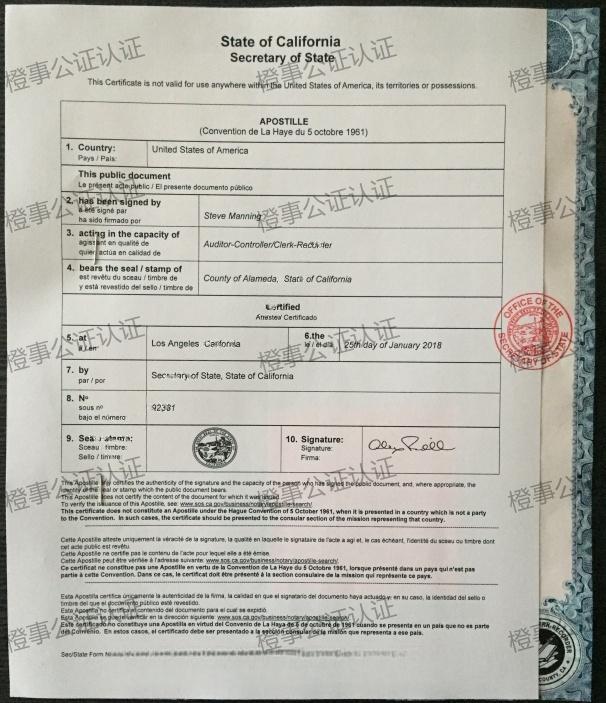
An apostille is verifiable because it is numbered. Every certificate follows the same twelve-field model agreed under the 1961 Hague Convention, so field 8 carries the certificate number, field 9 the seal, and field 10 the signature of the issuing officer. Those three are what a receiving authority checks.
- Hong Kong prints the verification address on the certificate itself, pointing to the Judiciary’s apostille verification page — anyone holding the document can check it without contacting the court.
- New York allows online verification of apostilles issued on or after 9 April 2013. Anything older has to be confirmed by telephone with the issuing unit.
- California, Florida, Georgia, Texas, DC, Nevada, Delaware, Massachusetts and the federal Office of Authentications publish no public certificate-number lookup. Verification is by contacting the issuing office with the number, the date and the name on the document.
- The United Kingdom publishes no lookup either; the Legalisation Office confirms a certificate on request.
It also helps to know what the certificate says about itself. The wording printed on the California and Hong Kong samples above is the standard text: the apostille certifies the authenticity of the signature, the capacity of the signer and the seal, and does not certify the content of the document. California adds a line worth reading twice — the certificate is not valid for use anywhere within the United States, its territories or possessions. A domestic agency will not accept an apostille, and waiting for one will not help.
13. FAQ
How long does an apostille take in total?
From one business day to about 25 working days for the certificate itself, plus however long the certified copy takes to obtain. A realistic end-to-end figure for a birth certificate ordered by mail is four to twelve weeks; for a document you already hold in certified form and can hand to a counter, it can be the same day.
The website says two weeks. Why has mine taken five?
Because the two weeks was about the certificate, and your file is waiting on something else. The three usual causes are a certified copy still in production, a payment that only cleared late, or a return label that had to be queried. Ask the office for the received-date they are currently working on — if it is after your delivery date, your file has not been opened yet.
Can I pay to speed it up?
In Nevada, Delaware and the United Kingdom, yes, and the published tiers are in section 7. In California, Florida, Georgia, Massachusetts, New York, Texas, DC and Hong Kong there is no expedited tier at all. The only lever there is physical: someone hands the document to a clerk.
Does an e-Apostille count?
It counts if the receiving authority accepts electronic certificates. The UK issues one for £35 with a two-working-day turnaround, but not for birth, death, marriage, civil partnership or adoption certificates from the General Register Office, nor for ACRO or DBS certificates. Hong Kong offers an e-Apostille route through enrolled notaries. Ask the receiving authority before choosing it — a paper certificate is the safer default.
My document is in the US and I am abroad. What is the fastest legitimate route?
Have the certified copy sent directly from the issuing office to whoever will submit it, then use a counter rather than the post. A representative can usually act for you: DC allows third parties to submit, and Hong Kong allows a representative to submit and collect. The remaining risk is the return leg, which is why the prepaid label matters more than the postage cost.
The official fee is $3 to $30. Why does a service charge more?
Because the fee buys one page. The service covers the parts that generate the delay: ordering the certified copy from the right office, getting the notarial wording right the first time, producing a payment instrument the office accepts, and supplying a return label it will not reject. If any of those go wrong, the file re-enters the queue and the fee is paid again.
Can I do it myself?
Yes, and for one document in a city with a counter you probably should — the official fee is low and the counter is fast. It stops being the cheaper option when the record has to be ordered by mail, when a county step sits in the middle, or when the destination is not a Convention country and a consular stage follows.
Planning backwards from a deadline?
Send us the document type, the country of use and the date you need it by. We will tell you which authority handles it, how long its queue is running this week, and whether the timeline is realistic — before you pay anyone anything. Ask us a question →
Sources / last verified
All turnaround times, fees and processing-date readings in this article were taken from the issuing authorities’ own pages on 23 October 2026. The processing-date pages for California, Florida and Nevada were each showing a “last updated 22 October 2026” stamp when read. Sources: sos.ca.gov (current processing dates, request an apostille); dos.fl.gov (document processing dates, apostille and notarial certification); nvsos.gov (processing dates, apostille fees); dph.georgia.gov (vital records mail-in service); gsccca.org (apostille general information); sec.state.ma.us; dos.ny.gov; sos.state.tx.us; os.dc.gov; corp.delaware.gov; travel.state.gov (Office of Authentications); judiciary.hk (apostille service); gov.uk (get your document legalised). Fee and turnaround baselines for the state authorities not re-read on this date follow the same offices’ published schedules as verified on 21 October 2026.

