




HOPEGOLD (SHENZHEN) BUSINESS MANAGEMENT CONSULTING CO.,LTD
Global professional notarization and certification service agency
Contact Us
Hotline: +86-755-28261216
Email: Bruce@hopegold.cn

Hong Kong Documents Used in Mainland China: Why No Apostille Is Issued — and the Route That Works Instead
Hong Kong Documents Used in Mainland China: Why No Apostille Is Issued — and the Route That Works Instead
Hong Kong, China is covered by the Apostille Convention — but not for documents used in mainland China. Because the Hong Kong SAR is not a separate Contracting Party, no apostille is issued in either direction. Mainland-bound Hong Kong documents instead go through a China-appointed attesting officer and are transmitted by China Legal Service (HKSAR) Limited.
Who this guide is for
If your Hong Kong document is going to a Contracting Party other than mainland China or Macao — the United Kingdom, the United States, Australia, Canada, Singapore, Japan, Korea — and you can get to the High Court Building in Admiralty, do this yourself. The fee is HK$125 per application and the counter normally turns it around in two working days. Read Fees and processing time and Step-by-step, then go.
If the document is going to mainland China, stop before you pay anyone for an apostille. No apostille exists for that route, and a certificate bought for it will be rejected. Go straight to Hong Kong ⇄ mainland China below.
If you are outside Hong Kong, or the receiving authority has set a deadline — a mainland court hearing, a property transfer, a marriage registration, a probate filing — the friction is in the postal rules, the currency of the bank draft and the purpose wording on the certificate. Those three sections are where requests actually fail.
If it turns out to be more trouble than it is worth, you can Talk to us directly — you send the documents, we handle the rest.
What a Hong Kong apostille is, and when you need one
An apostille is the certificate created by the Hague Convention of 5 October 1961 (in force since 24 January 1965), which abolishes the requirement of legalisation for foreign public documents. As of the HCCH status table updated 30 June 2026 there are 130 Contracting Parties. The apostille does one narrow job: it certifies the signature, the capacity of the signatory and the seal or stamp on the document, so the receiving authority abroad can accept it without going through its own consulate.
Hong Kong has been covered by the Convention since 25 April 1965, when it was extended by the United Kingdom. When sovereignty returned to China the arrangement continued: a United Kingdom note of 11 June 1997 and a Chinese note of 3 June 1997 confirmed that the Convention continues to apply to the Hong Kong Special Administrative Region from 1 July 1997. Macao has applied it since 4 February 1969 and continues to do so from 20 December 1999.
Mainland China is the newest party: it acceded on 8 March 2023 and the Convention entered into force there on 7 November 2023. That single fact is what makes this topic confusing. China is a Contracting Party, Hong Kong is covered by the Convention — and yet a Hong Kong document going to Shenzhen or Shanghai still cannot carry an apostille. The next table shows why, in one line.
| Where the Hong Kong document will be used | Apostille available? | What you actually do |
|---|---|---|
| A Contracting Party other than mainland China / Macao (UK, US, Australia, Canada, Singapore, Japan, Korea …) | Yes | Apply to the Apostille Service Office, High Court Registry. HK$125 per application. |
| Mainland China | No — in either direction | China-appointed attesting officer, then transmission by China Legal Service (HKSAR) Limited. |
| A country that is not a Contracting Party at all | No | Consular legalisation through the destination country's consulate in Hong Kong. |
Which authority issues a Hong Kong apostille
Apostilles for Hong Kong are issued by the High Court of the Hong Kong Special Administrative Region. Applications are filed at the Apostille Service Office, High Court Registry (Counter no. 5), LG1/F, High Court Building. There is one counter and one office — no district offices, no satellite locations.
In the declaration China filed with the HCCH on 8 March 2023, the competent authorities designated for the Hong Kong SAR under Article 6 of the Convention are the Administrative Secretary, the Registrar of the High Court, the Senior Deputy Registrar of the High Court and the Deputy Registrar of the High Court. In practice you never choose between them: the registry counter handles the filing and the certificate is signed by a registrar.
| Item | Detail |
|---|---|
| Issuing authority | High Court of the Hong Kong SAR |
| Office | Apostille Service Office, High Court Registry, Counter no. 5, LG1/F, High Court Building |
| Payment counter | High Court Accounts Office at LG211 (fee is paid there after the document is accepted) |
| Online verification | judiciary.hk — Apostille verification page |
Which Hong Kong documents can be apostilled
The High Court accepts two broad categories of document. Everything else has to be turned into one of them first — which is usually where a first attempt fails.
| Category | Examples | What to watch |
|---|---|---|
| Public documents bearing the true signature of a Hong Kong SAR Government recognised officer | Marriage Certificate signed by the Deputy Registrar of Marriage; Certificate of Absence of Marriage Record; Birth and Death Certificate; Certificate of Registered Particulars; Business Registration Certificate; Certificate of Incorporation | A marriage certificate signed by a civil celebrant, or issued by a church or temple, is not accepted as it stands — obtain a certified true copy from the Record Office of the Marriage Registry first. |
| Documents signed by a Hong Kong notary public or a Commissioner for Oaths | Power of Attorney; certified true copy (notary public); Declaration (Commissioner for Oaths) | The signature must be the original. A photocopy of a notarised document is not apostillable. |
| Certificates of Incorporation and related company certificates | Certificate of Incorporation; Certificate of Change of Company Name; Certificate of Continuing Registration; certificate issued under section 305(1) of the Companies Ordinance | With effect from 16 January 2012, a print-out of a company search made within the 3 working days before submission must be attached to each original certificate. A photocopy of the print-out is acceptable; the certificate itself must be original. |
Fees and processing time (official figures)
These are the High Court's published figures. They are not estimates, and there is no expedited tier to buy — the two-working-day standard applies to walk-in filings, and the overseas postal route is slower by nature.
| Item | Official figure | Notes |
|---|---|---|
| Apostille fee | HK$125 per apostille application | Charged per application, not per page. |
| Standard processing time | Normally two working days | Working days are Monday to Friday, excluding General Holidays. |
| Overseas postal applications | Generally two weeks | Counted from the time the office receives all required documents. |
| Return by registered air mail | HK$15.50 in addition to the fee | Total = HK$125 × number of apostilles + HK$15.50. Check first that air mail to your area is available. |
| Payment methods in person | Cash, EPS, Octopus, FPS or cheque | Cheques payable to “Government of Hong Kong SAR”. |
| Payment by post | Bank draft only, in Hong Kong dollars | Payable to “the Government of Hong Kong SAR”. Do not send cash. Bank charges are borne by the applicant. |
| e-Apostille | Available through enrolled notaries public | The notary submits the digitally signed document online and pays online; you are notified by email when it is ready. |
| Service fee | Quoted per document type, number of copies and destination | Get a quote → |
Step-by-step: how to get a Hong Kong apostille
The in-person route is short, and it has a quirk that catches people out: the document is accepted at one counter and the fee is paid at a different office on a different floor.
- Confirm the destination is a Contracting Party other than mainland China or Macao, and confirm what the receiving authority actually wants. Some ask for an apostille plus a certified translation.
- Make sure the document is in apostillable form. Original public document, or a document signed by a Hong Kong notary public or Commissioner for Oaths. Replace a celebrant-signed marriage certificate with a certified true copy from the Marriage Registry.
- Take the document to the Apostille Service Office, High Court Registry, Counter no. 5, LG1/F, High Court Building.
- Pay at the High Court Accounts Office at LG211 — cash, EPS, Octopus, FPS or a cheque payable to “Government of Hong Kong SAR”. You receive a payment receipt.
- Return to LG1 with the receipt and collect a collection receipt for the document you submitted.
- Collect the apostilled document — normally after two working days. If you cannot collect it yourself, a representative may bring the collection receipt and collect it for you.
If your document was signed by a Hong Kong notary public who has enrolled for the e-Apostille Service, the whole thing can be done electronically: the notary submits the digitally signed document, pays online, and you receive an email notification when the e-Apostille is ready.

Hong Kong ↔ mainland China: why no apostille is issued, and the route that works
This is the section people get wrong, and it is worth reading twice, because the mistake is expensive: an apostille bought for a mainland filing is not a partial solution, it is a rejected document.
Why no apostille — the Convention needs two Contracting Parties
Article 1 of the Convention applies to public documents which have been executed in the territory of one Contracting Party and which have to be produced in the territory of another Contracting Party. Hong Kong satisfies the first half of that test and mainland China satisfies the second — but the two are not different Contracting Parties. The Contracting Party is China. The Hong Kong Special Administrative Region is part of China, and the Convention reaches it through China's declaration that the Convention continues to apply to the Hong Kong SAR.
Put the two facts side by side and the answer is unavoidable: a Hong Kong document produced in mainland China is a document executed and produced within the territory of the same Contracting Party. The Convention has nothing to say about it, and no apostille is issued. The same reasoning runs in the other direction — a mainland notarial document used in Hong Kong does not carry an apostille either.
Note carefully what China's declaration does and does not say. It states that the Convention continues to apply to the Hong Kong SAR and the Macao SAR, and it designates the Hong Kong authorities competent to issue apostilles. It does not contain a sentence reading “the Convention does not apply between the mainland and Hong Kong”. The conclusion comes from the structure of the Convention, not from a quoted line — and if you are briefing a lawyer or a court, that distinction matters.
What to use instead: a China-appointed attesting officer
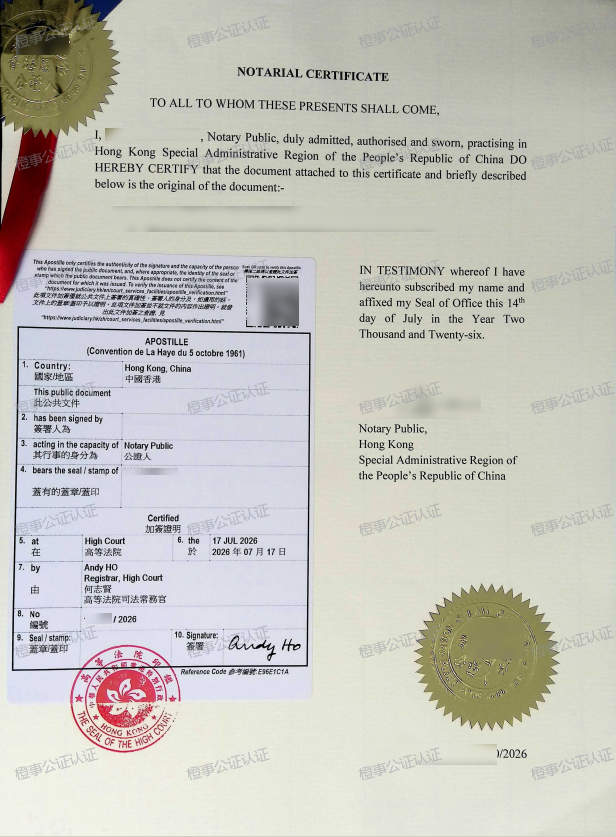
Hong Kong documents intended for use in mainland China follow the China-appointed attesting officer route. The framework is the Administrative Measures for China-Appointed Attesting Officers (Hong Kong) issued by the Ministry of Justice of the People's Republic of China (Order No. 69 of the Ministry of Justice, promulgated 24 February 2002, effective 1 April 2002).
Two provisions do the work. Article 3 defines the business scope: attesting acts performed in Hong Kong in respect of legal acts, facts of legal significance and documents occurring in Hong Kong, where the intended use is in mainland China. Article 5 requires the resulting notarial document to be submitted to China Legal Service (HKSAR) Limited for review and, where it conforms to the required procedures and format, to be transmitted with that company's endorsement. A certificate that has not gone through that transmission step does not travel.
The rule has teeth. The notice On Strictly Implementing the System of Attesting Officers and Certificate Transmission (Fa Ban Tong [1996] No. 032, dated 1 March 1996) records that a joint notice of the Supreme People's Court and the Ministry of Justice treats notarial documents that have not gone through this procedure as invalid certificates. In practice, a mainland court, land registry or civil affairs bureau will simply not accept them.
An attesting officer is not a generic notary. The appointment is made by the Ministry of Justice from among Hong Kong lawyers, for a term of three years and renewable on passing assessment. The qualifying conditions include holding Chinese citizenship with permanent residency in Hong Kong and having practised as a Hong Kong lawyer for at least ten years. That is why the signature on the certificate is one a mainland authority can check.
The wording trap on mainland-bound certificates
A transmitted certificate normally states a purpose limitation — for example, that the certificate is issued solely for use in handling litigation formalities in a named city. That wording is not boilerplate. If the certificate says the document is for a court filing in Beijing and you then try to use it at a bank in Shanghai, the receiving body is entitled to refuse it, and you start again. State the intended use and the intended city before the certificate is drawn up.
| Point of comparison | High Court apostille (overseas use) | Attesting officer certificate (mainland use) |
|---|---|---|
| Issued by | High Court of the Hong Kong SAR | A China-appointed attesting officer (a Hong Kong lawyer) |
| Additional step | None — the apostille is the final document | Transmission with endorsement by China Legal Service (HKSAR) Limited — mandatory |
| Official fee | HK$125 per application | Set by the attesting officer and by the transmission company; not a fixed government fee |
| Typical timeline | Normally two working days | Depends on the drafting, the signing appointment and the transmission review |
| If you get it wrong | Fee spent on a document nobody asked for | Certificate treated as invalid; the mainland body will not accept it |
Mail vs walk-in: which one to choose
If you are in Hong Kong, walk in. The postal route exists for people who are not, and it costs you two weeks plus a bank draft rather than two working days plus a queue number.
| Walk-in / representative | Post from overseas | |
|---|---|---|
| Payment | Cash, EPS, Octopus, FPS, or cheque | Hong Kong dollar bank draft only. No cash. |
| Documents to include | The document itself | A covering letter stating the purpose, the intended place of use, your overseas return address, email address and telephone number |
| Time | Normally two working days | Generally two weeks from receipt of all required documents, plus delivery time |
| Getting it back | Collect in person or send a representative with the collection receipt | Pre-paid courier at your own expense (faster and more secure) or registered air mail for HK$15.50 extra |
Where overseas applicants get stuck
- The bank draft has to be in Hong Kong dollars, drawn on a bank, payable to “the Government of Hong Kong SAR”. Your own bank's charges for issuing it are yours to bear, and they are not refunded if the application is returned.
- Cash sent by post is not accepted. The office states it plainly. Documents mailed with cash are not a shortcut.
- The covering letter is a real requirement, not a courtesy. Purpose, intended place of use, overseas return address, email address and telephone number — all five. A missing return address is a stalled file.
- Registered air mail depends on whether air mail reaches you. Check the Hongkong Post service notices for your destination before you rely on it; if the service is suspended, the certificate has no way home.
- The two weeks is measured from receipt of a complete application. A query about the payment instrument restarts that clock in practice.
- Postal risk is on you. The office warns about documents arriving creased, damaged or lost and asks you to protect them; a creased certificate of incorporation is a problem you cannot fix from abroad.
- Someone in Hong Kong can act for you. An overseas applicant may send a person in Hong Kong to bring the document, pay the fee in cash in person and collect the apostilled document on your behalf — often the cheapest way to avoid the draft, the postage and the wait.
- Nobody can verify a mainland-bound certificate for you from abroad if the purpose wording is wrong. That is checked by the mainland body that receives it, after the fact.
Cost breakdown: what you actually pay, and to whom
The fee is small and it is not the whole bill. There are three separate pockets, and no single party can collect the others' share for you.
| Layer | What it covers | Who you pay |
|---|---|---|
| Official fees | HK$125 per apostille application; HK$15.50 if returned by registered air mail | Government of the Hong Kong SAR |
| Your own costs | Bank draft charges; courier or postage; certified true copies from the relevant registry; translation where the receiving authority demands it; your time | Your bank, your courier, the registry, the translator |
| Service fee | Quoted per document type, number of copies and destination | Your agent — ask for a quote |
When it makes sense to use a service
The official fee is low, and for a straightforward walk-in filing you do not need anyone's help. Consider handing it over when one or more of these applies:
- The destination is mainland China. You are not buying an apostille at all; you are drafting, signing and transmitting an attesting officer certificate, and the drafting is where errors become invalid documents.
- You are not in Hong Kong and cannot send a representative, so the bank draft, the covering letter and the return leg all have to be arranged from abroad.
- The document is a company certificate that needs a company search print-out made within the previous three working days — the timing has to be sequenced, not guessed.
- The receiving authority has specified a format — a certified translation, a particular purpose statement, a named city — and you want it checked before signing rather than after rejection.
- The document is a marriage certificate signed by a celebrant, a church or a temple, so a certified true copy has to be obtained from the Marriage Registry before anything else can start.
- You want to reduce the risk of a rejected filing. A returned application costs you the fee, the postage and the deadline.
Common rejection reasons
- Asking for an apostille for a mainland China filing. No apostille exists for that route. This is the most expensive misunderstanding on this page.
- A photocopy where the original is required. The apostille is affixed to the document; a copy has nothing valid to attest.
- A marriage certificate signed by a civil celebrant or issued by a church or temple. Obtain a certified true copy from the Record Office of the Marriage Registry first.
- A Certificate of Incorporation without a company search print-out made within the previous three working days. Required since 16 January 2012, on each original certificate.
- Cash sent through the post. Not accepted, and not returned in any useful sense.
- A bank draft in the wrong currency or payable to the wrong name. It must be in Hong Kong dollars and payable to “the Government of Hong Kong SAR”.
- An incomplete covering letter. Purpose, intended place of use, return address, email and telephone number — all five.
- A document not signed by a Hong Kong notary public, a Commissioner for Oaths, or a recognised Hong Kong SAR Government officer. A foreign notary's signature is not a Hong Kong signature.
- A mainland-bound certificate with the wrong purpose wording. The certificate limits itself to the use and the place named in it.
If you would rather have the route confirmed before you spend anything, Contact us → and tell us the document type, the destination and the deadline. We will tell you which of the two routes applies — including when the answer is that you can do it yourself.
How to verify a Hong Kong apostille is authentic
Hong Kong is one of the jurisdictions that publishes an online verification service for apostilles, so the receiving authority can check a certificate rather than take it on trust. The verification page is on the Judiciary website at judiciary.hk/en/court_services_facilities/apostille_verification.html.
Second, read the annotation. Since 23 July 2012 apostilles issued in Hong Kong carry a note at the top which reads: “This apostille only certifies the signature, the capacity of the signatory and the seal or stamp it bears. It does not certify the content of the document for which it is issued.” That sentence is the authoritative statement of what an apostille does and does not do, and it is the answer to anyone who thinks an apostille validates the contents of a contract or a certificate.
Third, if a document looks wrong, check it against the office that issued it. The Apostille Service Office at the High Court Registry is the only body that can confirm a Hong Kong apostille, and it is the only body that issues one.
FAQ
Does a Hong Kong document need an apostille to be used in mainland China?
No. The Convention requires two different Contracting Parties, and the Hong Kong SAR and mainland China are parts of the same Contracting Party. No apostille is issued in either direction. The route for mainland use is a China-appointed attesting officer certificate transmitted by China Legal Service (HKSAR) Limited.
How much does a Hong Kong apostille cost?
HK$125 per apostille application, charged by the High Court. If you ask for the document to be returned by registered air mail, add HK$15.50.
How long does it take?
Normally two working days for a filing at the counter. An application sent by post from overseas generally takes two weeks from the time the office receives all the required documents, plus the time the return delivery takes.
Can I mail my document from overseas?
Yes. Include a covering letter with the purpose, the intended place of use, your overseas return address, email address and telephone number, and pay by a Hong Kong dollar bank draft payable to “the Government of Hong Kong SAR”. Do not send cash. Alternatively, send someone in Hong Kong to file and collect it in person — often faster and cheaper.
Can I get an e-Apostille myself?
Not directly. The e-Apostille Service is open to notaries public who have enrolled for it; they submit the digitally signed document and pay online, and you are notified by email when it is ready. If your document has to be notarised anyway, ask the notary whether they are enrolled.
The official fee is only HK$125. Why would I pay a service fee?
For a straightforward walk-in apostille, you should not. A service earns its place when the destination is mainland China and the work is drafting and transmitting an attesting officer certificate; when you cannot be in Hong Kong and the bank draft, covering letter and return leg have to be arranged from abroad; or when the receiving authority has specified a format that needs checking before the certificate is signed rather than after it is refused.
Can I do this myself?
For an overseas-use apostille in Hong Kong, yes — take the original document to Counter no. 5 on LG1/F of the High Court Building, pay HK$125 at LG211 and collect two working days later. The two things you cannot skip are making sure the document is in apostillable form and making sure the destination is not mainland China or Macao.
Not sure which route your document needs? Tell us the document type, where it will be used and your deadline, and we will set out the steps, the official fees and the timeline — Ask us a question → The consultation is free, and there is no obligation and no follow-up pressure.
Sources and last verified
- HCCH, Status table — Convention of 5 October 1961 Abolishing the Requirement of Legalisation for Foreign Public Documents, updated 30 June 2026 (130 Contracting Parties; Hong Kong application from 25 April 1965 and continuation from 1 July 1997; Macao from 4 February 1969 and continuation from 20 December 1999; China accession 8 March 2023, entry into force 7 November 2023).
- HCCH, notification and declaration of the People's Republic of China, 8 March 2023 (continuation of the Convention in respect of the Hong Kong SAR and the Macao SAR; designation of the Hong Kong authorities competent to issue apostilles).
- Hong Kong Judiciary, Apostille Service — documents accepted, HK$125 per application, two working days, two weeks for overseas postal applications, HK$15.50 registered air mail, payment methods, the company-search rule of 16 January 2012.
- Hong Kong Judiciary, Apostille verification service, and the annotation carried on Hong Kong apostilles since 23 July 2012.
- Ministry of Justice of the People's Republic of China, Administrative Measures for China-Appointed Attesting Officers (Hong Kong), Order No. 69 of the Ministry of Justice, promulgated 24 February 2002, effective 1 April 2002 (Articles 3 and 5; appointment term of three years).
- Notice on Strictly Implementing the System of Attesting Officers and Certificate Transmission, Fa Ban Tong [1996] No. 032, dated 1 March 1996 (notarial documents not transmitted through the prescribed procedure are invalid certificates).
Last verified: 5 October 2026. Fees, office arrangements and processing times are set by the issuing authorities and can change; confirm them with the High Court Registry before you rely on them.

